
 Submit a TILF
The word weird originally meant fate or destiny. Derived from the Old English wyrd, calling someone weird in ancient times was essentially declaring them to be a powerful, inevitable force of the univ
The sources below were found by search, checked to be reachable, and support this claim as stated.
“Weird” used to mean fate or destiny. It comes from Old English wyrd, connected with what was destined to happen; supernatural associations eventually helped push it toward its modern meaning. So technically, when someone says “you’re weird,” your ancestors might hear “you are the inevitable hand of fate.”
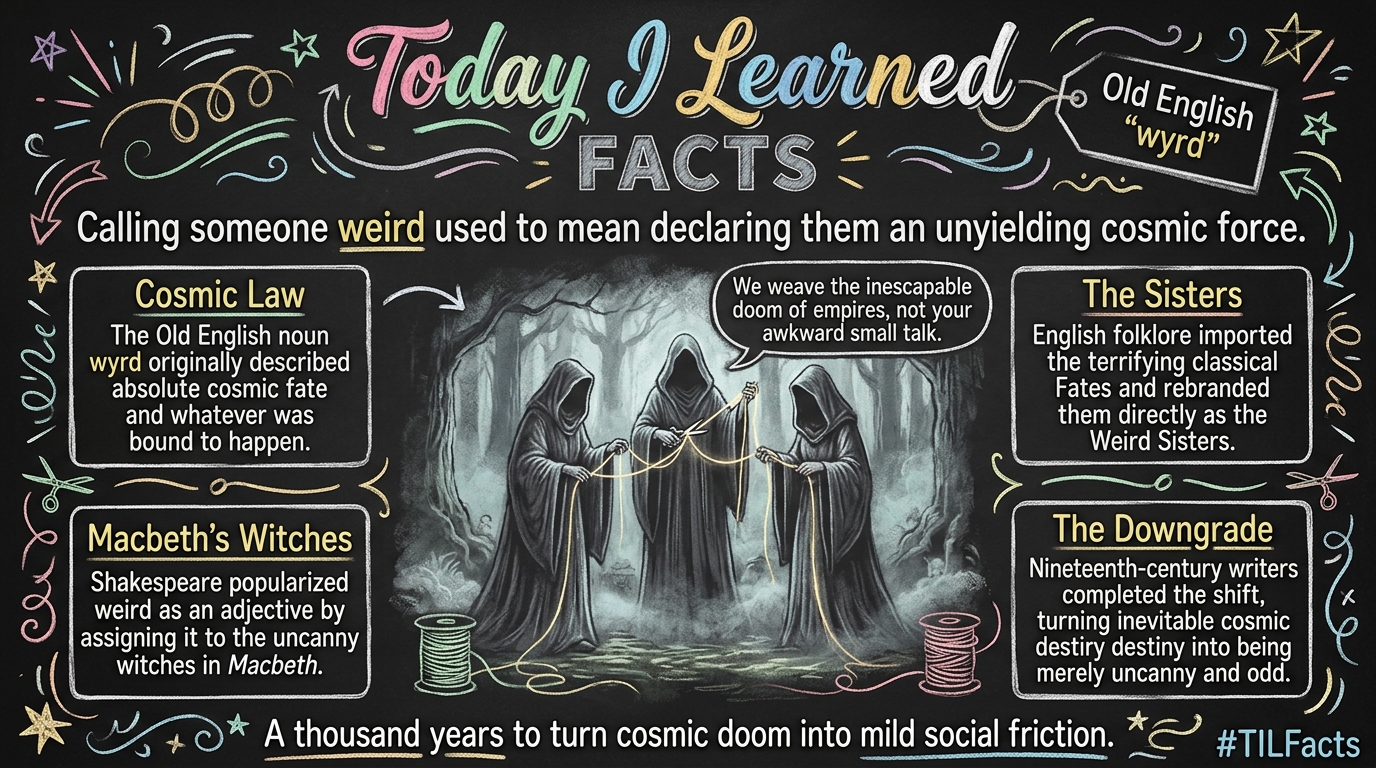
Calling someone weird used to mean calling them an inevitable cosmic force. The word comes from the Old English noun wyrd, which referred to fate, destiny, or what must come to pass. Shakespeare and later poets helped twist the concept into uncanny sorcery, eventually downgrading a cosmic law into an awkward quirk.
Key Highlights
- 1Old English wyrd originally referred to absolute fate and cosmic destiny.
- 2The classical Fates were translated into English folklore as the Weird Sisters.
- 3Shakespeare popularized the adjective by applying it to the witches in Macbeth.
- 4Nineteenth-century writers shifted the meaning from fateful to uncanny and odd.
The Deep Dive
In Anglo-Saxon culture, wyrd was not an insult. It was the fundamental concept of fate, woven into the fabric of the universe and controlling the destiny of mortals and gods alike. To an Old English speaker, wyrd was the unyielding force dictating what happened next, rooted in a Proto-Germanic verb meaning to turn or to become.
The transition from cosmic inevitability to oddity began with mythology. Classical myths of the three Fates who spin human destiny were translated into English folklore as the Weird Sisters. In Scots and Middle English, the noun gradually shifted into an adjective describing beings who possessed the power to control or foretell destiny.
William Shakespeare cemented this pivot in Macbeth when he introduced the Weird Sisters as predicting witches. Early modern audiences associated the term directly with supernatural prophecies and magical foreknowledge. By the time 19th-century Romantic poets like Percy Bysshe Shelley picked it up, the word had migrated from controlling fate to merely possessing an eerie, uncanny atmosphere.
Modern speakers usually assume the word was always a mild social descriptor. Instead, the English language spent centuries steadily diluting a terrifying metaphysical certainty. The shift from having power over destiny to being uncanny, and finally to simply being socially eccentric, took roughly a thousand years of linguistic drift.
Every time you call something weird today, you are using the ghost of an ancient pagan fatalism. It raises the question of which other grand cosmological terms are currently undergoing a thousand-year demotion into office small talk.
Discussion
No comments yet. Be the first to share what you found surprising.