
 Submit a TILF
The debate over whether an Irish merchant named gasoline by altering trademarks
Credible sources disagree on this claim; both sides are presented below.
An Irish shopkeeper swapped the C for a G to pirate the Gas.
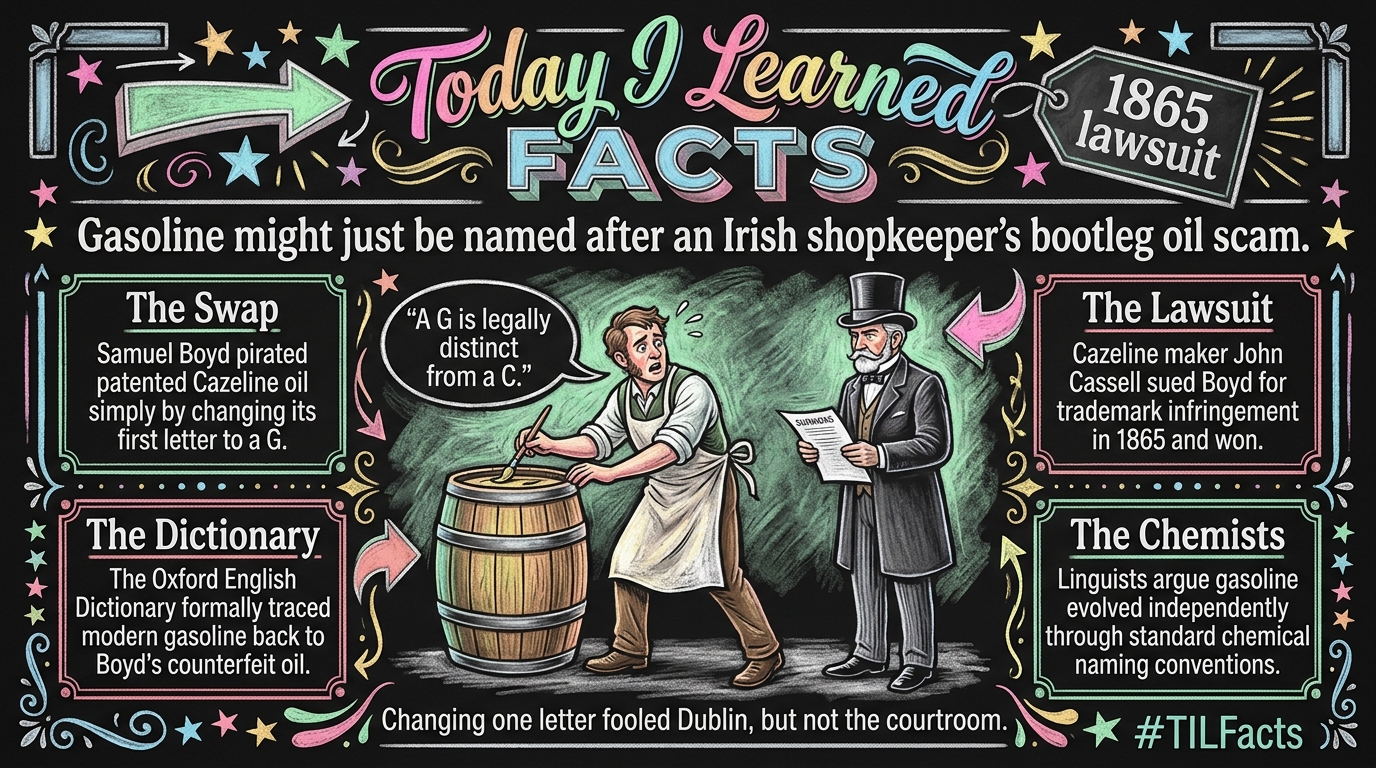
Historians dispute whether the word gasoline originated from a Dublin shopkeeper pirating a lamp oil brand. In the 1860s, Samuel Boyd swapped the initial letter of John Cassell's patented oil Cazeline to sell counterfeit Gazeline, prompting an 1865 trademark lawsuit. While the Oxford English Dictionary links gasoline to this scam, linguists show it also evolved independently as a standard scientific coinage.
Key Highlights
- 1Samuel Boyd swapped the C in patented Cazeline oil to G to sell knockoff Gazeline.
- 2John Cassell successfully sued Boyd for trademark infringement in an 1865 court case.
- 3The Oxford English Dictionary traced modern gasoline to Boyd's pirated oil brand.
- 4Linguists argue gasoline arose naturally from standard chemical naming conventions.
The Deep Dive
The legend begins with a classic patent dispute in 1860s Dublin. Publisher and businessman John Cassell sold a popular patented illuminating lamp oil called Cazeline. A local shopkeeper named Samuel Boyd bought Cassell's stock, ran out of supply, and chose not to buy more. Instead, Boyd concocted his own formula, changed the leading C to a G, and sold counterfeit barrels under the name Gazeline.
Cassell took Boyd to court in an 1865 landmark trademark infringement suit. Boyd argued in court that he had coined the word Gazeline from the French word gaz and standard chemical suffixes. The judge dismissed Boyd's explanation as an obvious cover story, ruling entirely in Cassell's favour and permanently enjoining Boyd from selling his knockoff blend.
Lexicographers at the Oxford English Dictionary famously traced the global adoption of gasolene and gasoline directly back to Boyd's pirated brand. In their reading, the knockoff label crossed the Atlantic and attached itself to petroleum distillates that powered internal combustion engines, eventually shortening to gas in American parlance.
Linguists and historians of chemistry strongly challenge that single-origin narrative. Records from the 1860s show American and European chemists creating oil and gas derivatives using standard suffixes like -ol and -ine without any connection to Dublin storefront drama. The word gasolene appeared in American trade advertisements and scientific papers around the exact same period, formed predictably from the noun gas.
Boyd certainly pirated Cazeline by swapping a single letter, but whether his counterfeit brand created an everyday word remains a genuine historical split. One camp credits a Dublin court dispute with naming modern vehicle fuel, while the other sees an ordinary chemical term that would have emerged regardless.
Sources
Discussion
No comments yet. Be the first to share what you found surprising.