
 Submit a TILF
How NASA Fixed A Critical Software Flaw On Mars From 100 Million Miles Away
The sources below were found by search, checked to be reachable, and support this claim as stated.
A Single Faulty Coding Error Almost Destroyed The Mars Pathfinder
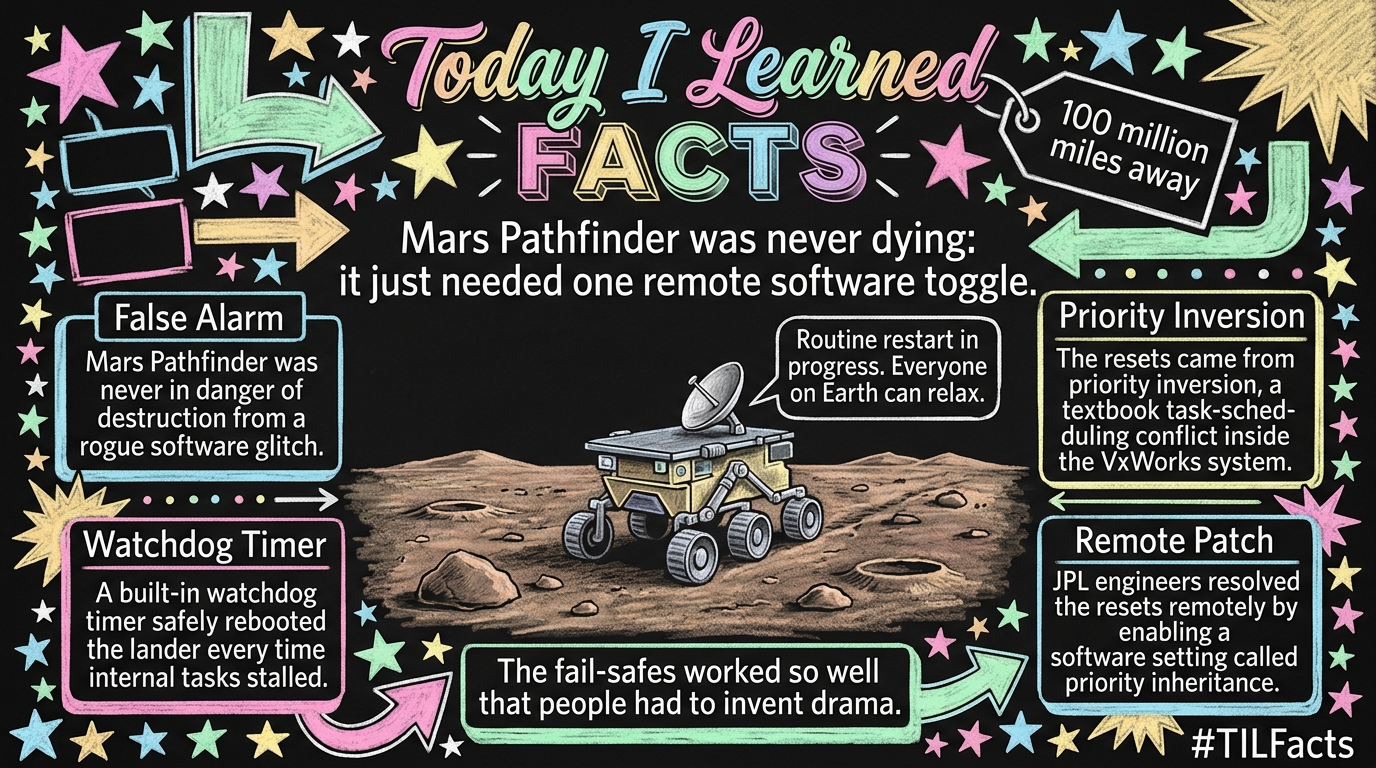
Mars Pathfinder was never on the brink of destruction from a coding error. In July 1997, the lander experienced routine software resets caused by a classic scheduling conflict known as priority inversion. Built-in fail-safes rebooted the craft safely every time until NASA engineers uploaded a clean remote patch.
Key Highlights
- 1Mars Pathfinder was never in danger of destruction from a software glitch.
- 2The issue was a scheduling conflict called priority inversion in VxWorks.
- 3A watchdog timer safely rebooted the lander whenever tasks stalled.
- 4JPL engineers resolved the resets remotely by enabling priority inheritance.
The Deep Dive
Shortly after landing on Mars in July 1997, Mars Pathfinder began experiencing unexpected system restarts. Pop culture accounts quickly dramatised the glitch into a nail-biting rescue where the lander supposedly hung by a single line of bad code. In reality, the spacecraft was functioning exactly as built. Its watchdog timer noticed that tasks were stalling and executed standard system reboots to clear the digital jam. At no point was the vehicle in physical danger.
The real issue was a classic computer science trap called priority inversion within the VxWorks real-time operating system. A low-priority meteorological task acquired a shared memory lock, or mutex, on the information bus. Before it could release the lock, medium-priority communications tasks woke up and preempted it. Meanwhile, the high-priority bus management thread needed that exact lock and was forced to wait. Because the medium-priority tasks starved the low-priority task, the high-priority thread was blocked indefinitely.
The watchdog timer caught the high-priority thread stalling and triggered a reboot before any data corruption or hardware damage could occur. While the resets were inconvenient and delayed science operations, the mission architecture handled them gracefully. The spacecraft saved its telemetry, restarted cleanly, and awaited commands from Earth.
Back at NASA's Jet Propulsion Laboratory, engineers reproduced the exact timing bug on a ground replica. The fix did not require rewriting broken flight logic from scratch. The operating system already included a built-in flag for priority inheritance, an algorithmic rule where a low-priority task temporarily borrows the higher priority of any thread waiting on its lock. The team uploaded a short script that flipped this parameter on in the C initialization code.
The myth of imminent destruction largely stems from conflation with genuine space software disasters, such as the missing hyphen on Mariner 1 or the metric conversion blunder that doomed the Mars Climate Orbiter. Pathfinder, by contrast, was a textbook demonstration of defensive systems engineering. The real question is how a routine operating system patch evolved in the public imagination into an interplanetary disaster thriller.
Sources
Discussion
No comments yet. Be the first to share what you found surprising.