
 Submit a TILF
The word clue originally meant a literal ball of yarn, inspired by the ancient Greek myth of Theseus escaping the Minotaur's labyrinth.
The sources below were found by search, checked to be reachable, and support this claim as stated.
The word "clue" originally meant "ball of yarn".
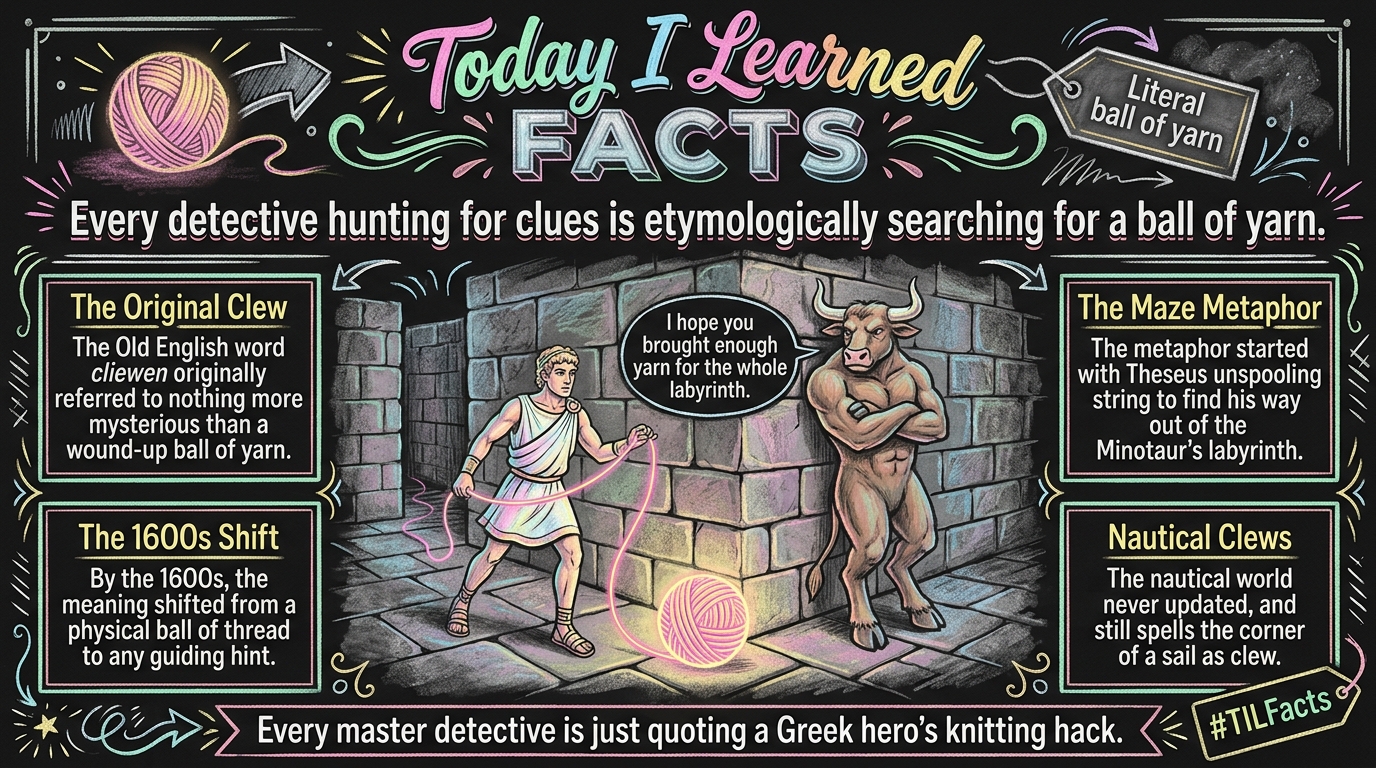
Before it was evidence in a murder mystery, a clue was just a ball of thread. The word comes from the Old English term for a wound-up ball of yarn, spelled clew. English speakers used it to describe unravelling a complicated problem because of the Greek myth of Theseus following a string out of a monster's maze.
Key Highlights
- 1Old English 'cliewen' originally referred to a literal wound-up ball of yarn.
- 2The metaphor came from Theseus using string to escape the Minotaur's labyrinth.
- 3By the 1600s, the meaning shifted from physical thread to a guiding hint.
- 4The nautical world still spells the corner of a sail as 'clew'.
The Deep Dive
In Old and Middle English, if you held a 'clew', you were simply holding a tightly wound sphere of yarn or twine. It had nothing to do with crime scenes, detectives, or mysteries. It was a purely textile term derived from the Old English 'cliewen', sitting alongside everyday household chores.
The word began its conceptual shift thanks to classical mythology. In the legend of the Minotaur, Ariadne hands Theseus a ball of thread so he can venture into the Cretan labyrinth, slay the beast, and follow the unravelled line back to the exit. English writers began using 'clew' as a metaphor for anything that guides someone through a maze or out of a baffling situation.
By the seventeenth century, the figurative meaning started taking over the literal one. Having a 'clew' shifted from physically holding Ariadne's string to having the thread of an argument or a hint that leads to a solution. As the metaphor drifted further from knitting, the spelling mutated into 'clue'.
Modern speakers often assume the word came out of early police procedural work or British legal systems. In reality, criminal investigators simply inherited a Greek dungeon survival hack that poets had been using as a figure of speech for centuries. The board game and detective tropes arrived long after the textiles were forgotten.
Today, the nautical world still uses the original spelling 'clew' to describe the lower corner of a sail, but everywhere else, the yarn has vanished. When you say you have 'no clue', you are technically complaining that nobody gave you a ball of string to navigate reality.
Discussion
No comments yet. Be the first to share what you found surprising.