
 Submit a TILF
The Trojan Horse never appears in Homer's Iliad, was barely mentioned in The Odyssey, and everything we picture today comes from a Roman poet writing 700 years later.
The sources below were found by search, checked to be reachable, and support this claim as stated.
History's most iconic military trap, the Trojan Horse, never actually appears in Homer's Iliad and is only mentioned in passing in The Odyssey, meaning everything we picture today was popularized 700 years later by a Roman poet, depicted on ancient pottery with literal window portholes, and may have actually been a mistranslated Phoenician warship.
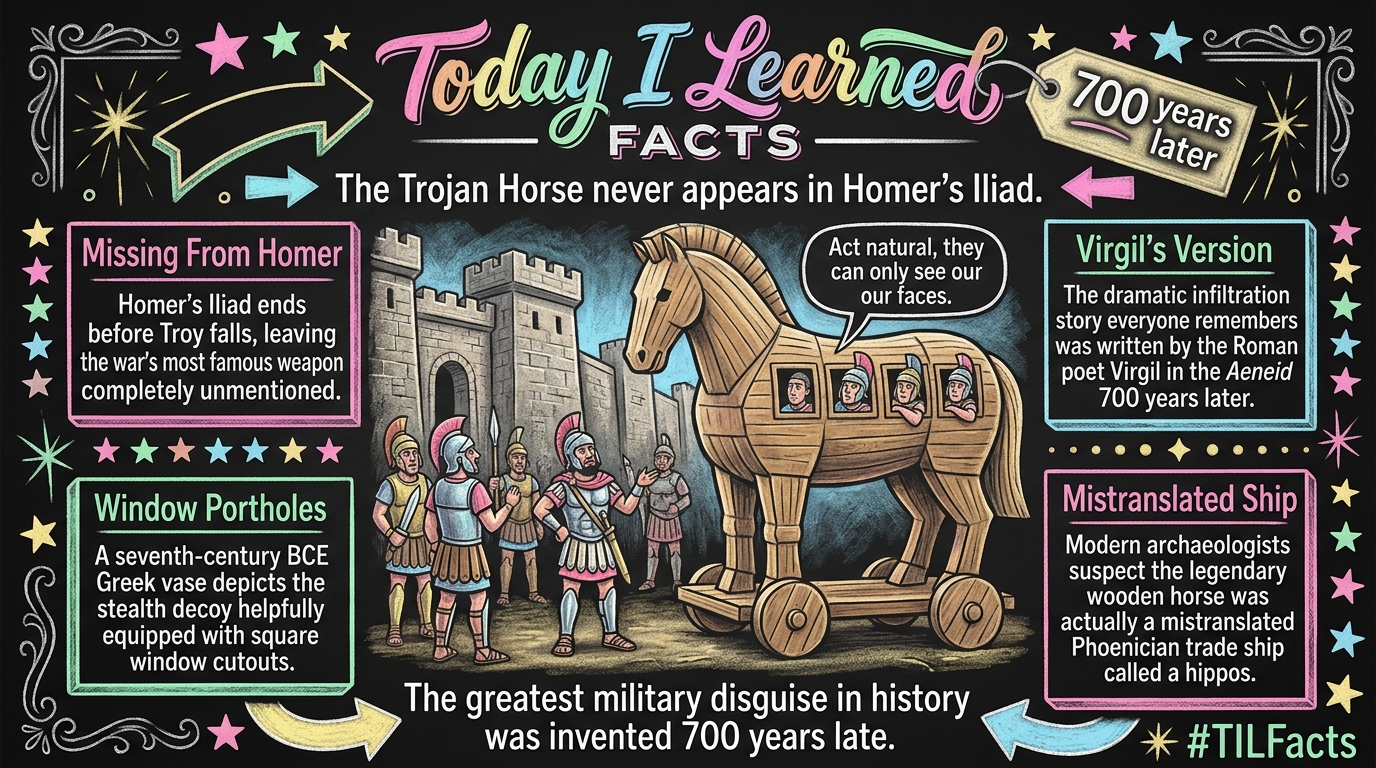
History's most famous military ruse is completely absent from Homer's Iliad, which ends before Troy even falls. Homer barely gave the wooden horse a passing nod in The Odyssey, leaving the dramatic story we know today to Roman poet Virgil writing seven centuries later. Ancient Greek pottery even depicted the machine with bizarre window portholes, and modern archaeologists suspect the whole myth was just a mistranslated Phoenician trade ship.
Key Highlights
- 1Homer's Iliad ends before Troy falls, leaving the wooden horse out entirely.
- 2Virgil wrote the detailed infiltration story in the Aeneid 700 years later.
- 3A 7th-century BCE Greek vase shows the horse equipped with square window cutouts.
- 4Archaeologists suspect the 'horse' was actually a Phoenician ship type called hippos.
The Deep Dive
The Iliad spends twenty-four books detailing bronze-age rage, divine intervention, and the brutal siege of Troy, but it stops abruptly at the funeral of Hector. The city has not fallen, the Greeks have not sailed away, and nobody has built a giant wooden quadruped. Readers expecting the legendary infiltration will find Homer moving straight to the aftermath, leaving the horse as an unwritten footnote.
When the horse finally surfaces in Homer's Odyssey, it gets only brief, retrospective mentions as a clever trick orchestrated by Odysseus. The blockbuster version of the tale—the fake Greek surrender, the suspicious priest, and the midnight massacre—was fleshed out 700 years after Homer by the Roman poet Virgil in Book 2 of the Aeneid. Rome needed a heroic origin myth, and Virgil provided the definitive script.
Archaeological evidence shows the ancients were already confused about what the contraption looked like. The earliest known depiction of the trap, found on the seventh-century BCE Mykonos pithos vase, portrays a wheeled wooden beast lined with literal square window portholes showing soldiers' heads peeking out. It looked less like an impenetrable covert machine and more like a poorly disguised wooden bus.
Modern maritime archaeologists have proposed a far more practical explanation: the horse might not have been a horse at all. Researcher Francesco Tiboni noted that ancient Greeks referred to Phoenician cargo vessels with horse-headed prows as 'hippos.' Over centuries of oral storytelling, a naval assault involving a horse-head ship type likely morphed into a literal wooden animal walking through the city gates.
Whether an engineering feat, a Roman embellishment, or an ancient maritime pun taken literally, the legend outlasted the city it allegedly destroyed. A tactical ruse that started as a passing line in an epic poem became history's most durable cautionary tale about accepting gifts from strangers.
Sources
Discussion
No comments yet. Be the first to share what you found surprising.