
 Submit a TILF
Wombats sculpt eighty sharp cubes every night through a round exit.
The sources below were found by search, checked to be reachable, and support this claim as stated.
Wombats produce cube-shaped droppings.
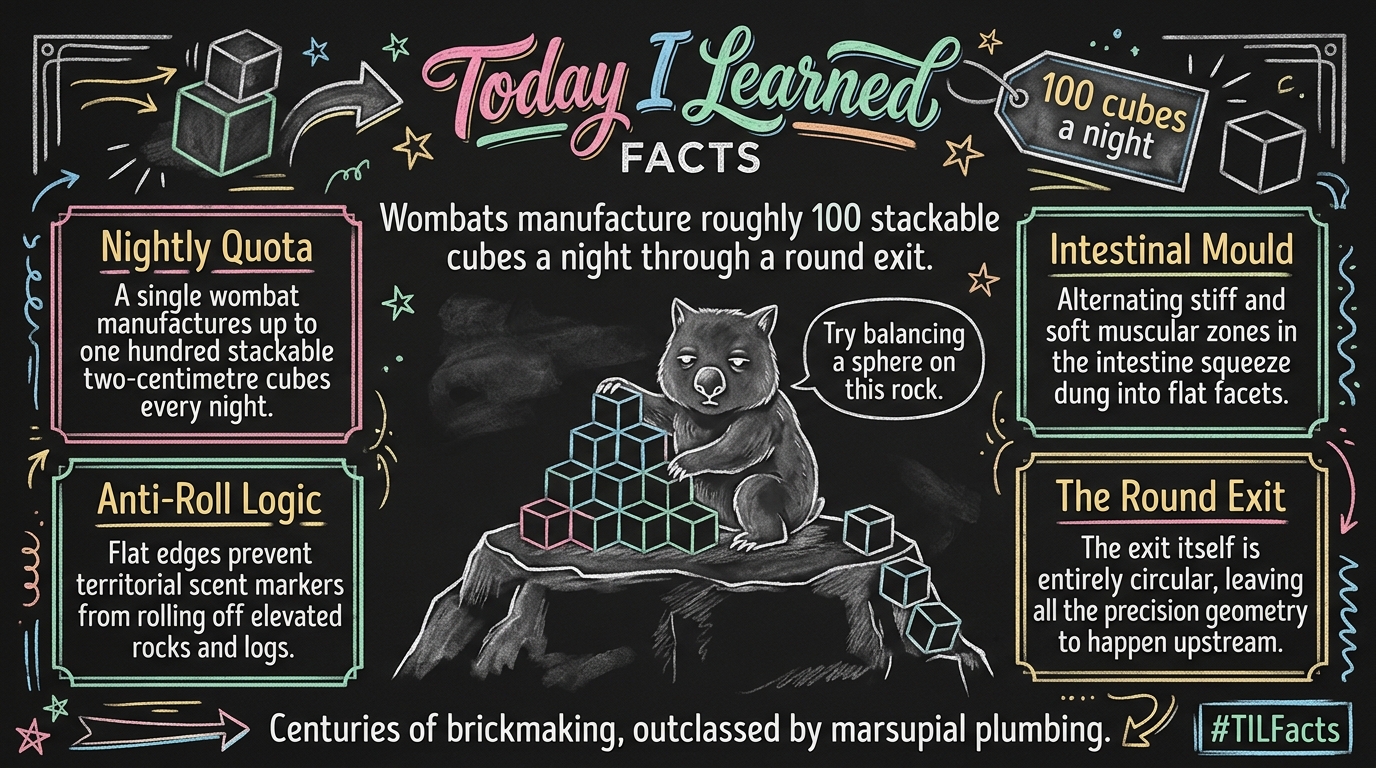
Wombats produce roughly one hundred cube-shaped droppings every single day. The bare-nosed wombat (*Vombatus ursinus*) shapes them in the final section of its intestine, where alternating stiff and flexible muscle bands press the drying dung into flat edges. Depositing these geometric blocks on elevated rocks and logs keeps scent markers from rolling away. It is the only known creature that manufactures right angles inside its digestive tract.
Key Highlights
- 1Wombats deposit up to 100 stackable two-centimetre cubes every single night.
- 2Alternating stiff and soft intestinal walls squeeze the feces into flat facets.
- 3Cube geometry stops scent-marking droppings from rolling off elevated rocks.
- 4The wombat's anal sphincter is circular; all cube shaping happens upstream.
The Deep Dive
Australian bushwalkers have spent decades finding neat piles of brown dice perched on top of rocks, fallen logs, and dirt mounds. The architect is the bare-nosed wombat (*Vombatus ursinus*), a stocky, burrowing marsupial that produces eighty to one hundred two-centimetre cubes every night. Wombats have terrible eyesight and navigate the world by scent. Elevating their droppings on prominent perches acts like a billboard for territorial boundaries and mating signals, and a cube has the distinct structural advantage of staying where it was put rather than rolling downhill.
Manufacturing a flat-sided prism inside a living body requires unusual plumbing. Biomechanical fluid tests show that the dung remains slurry-like through the first ninety percent of the wombat's digestive tract. The shaping happens exclusively in the final eight percent of the intestine. Here, the intestinal wall varies in elasticity, alternating between two stiff grooves and two flexible regions. As the tract contracts rhythmically to pull out moisture, the stiff sections press flat facets into the solidifying dung, while the flexible sections form the corners.
The physics of the wombat cube remained an unexamined folk mystery until biomechanics researcher Patricia Yang and fluid dynamicist David Hu examined deceased wombats in Tasmania. By inflating the excised intestines with long balloons and mapping local tissue strain, the research team demonstrated that intestine stiffness varies azimuthally by two to three fold. Their published 2021 study in the journal *Soft Matter* proved that internal wall mechanics alone create the geometry, earning the team an Ig Nobel Prize in Physics.
The persistent myth that wombats possess a square anus is entirely wrong. The animal has a standard, circular anal sphincter. The feces are already fully formed, dried, and faceted into rigid cubes before reaching the exit, and passing through a round sphincter does not alter their shape any more than pushing a sugar cube through a rubber ring. The animal also does not manually pat or sculpt the droppings with its paws after defecating, a folk belief born from observers struggling to accept automated biological bricklaying.
Human manufacturing currently relies on cutting, moulding, or 3D-printing to produce squared items. The wombat is the only biological system known to extrude sharp corners using rhythmic squeezing in a non-uniform tube. Mechanical engineers are now studying wombat intestinal architecture to design continuous manufacturing pipelines for ceramics, clay, and pharmaceuticals without using rigid metal dies. A nocturnal Australian marsupial solved industrial extrusion millions of years before humans built their first factory.
Discussion
No comments yet. Be the first to share what you found surprising.