
 Submit a TILF
When the Mona Lisa vanished from the Louvre in 1911, French detectives were so baffled that their top suspect was none other than a young Pablo Picasso.
Credible sources disagree on this claim; both sides are presented below.
Mona Lisa was famously stolen from the Louvre in 1911, the police were so desperate for leads that they brought in a young Pablo Picasso as a prime suspect and interrogated him.
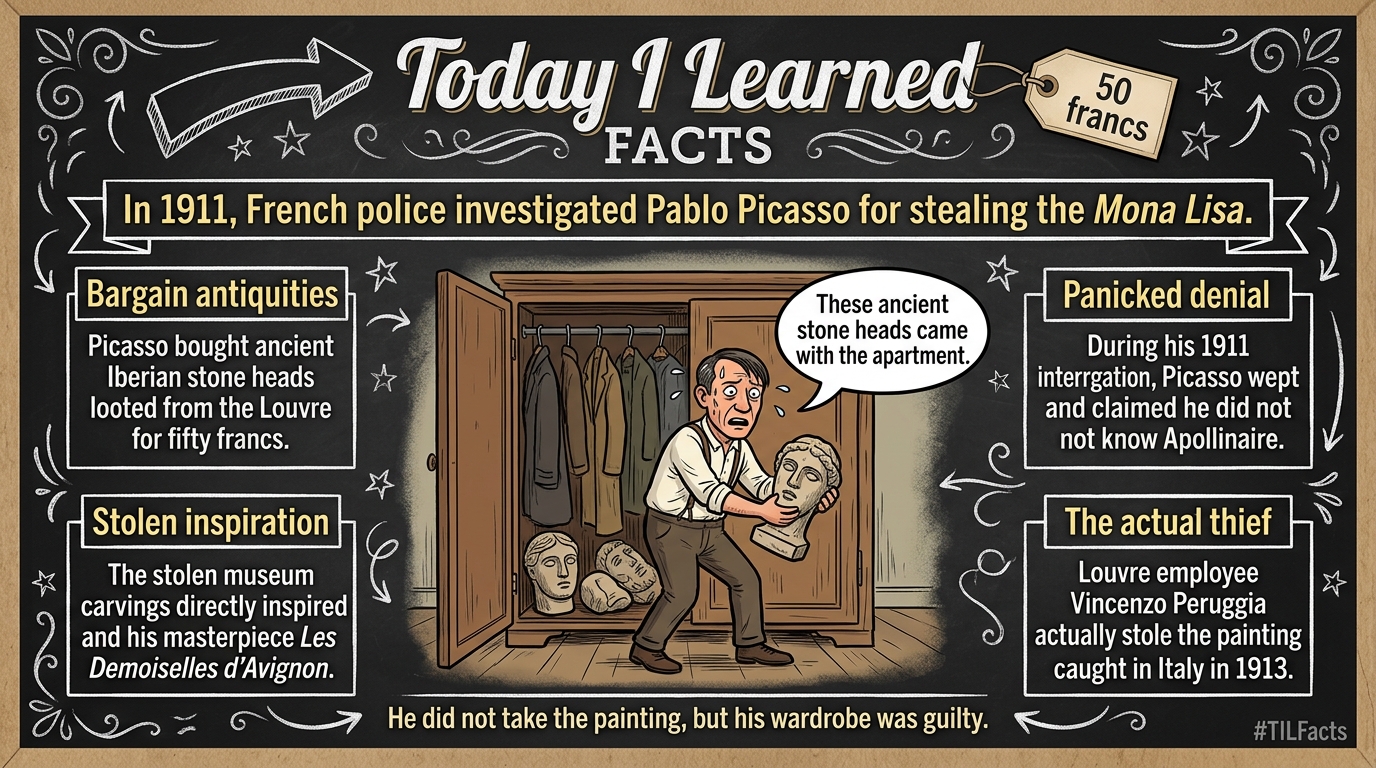
Pablo Picasso was interrogated for the 1911 Mona Lisa theft, but not because French investigators were randomly grasping for leads. A mutual acquaintance had repeatedly looted ancient Iberian stone sculptures straight out of the Louvre and sold them to Picasso for pocket money. When the painting disappeared, the paper trail of Parisian art fencing led a magistrate straight to Picasso's apartment.
Key Highlights
- 1Picasso bought Iberian stone heads looted straight from the Louvre for fifty francs.
- 2The stolen museum carvings directly inspired his masterpiece Les Demoiselles d'Avignon.
- 3Picasso wept during his 1911 interrogation and claimed he did not know Apollinaire.
- 4The actual thief was Louvre employee Vincenzo Peruggia, caught in Italy in 1913.
The Deep Dive
On August 21, 1911, the Mona Lisa vanished off the wall of the Louvre, leaving behind four empty wall hooks and an international public relations catastrophe. French police sealed the borders, checked passenger luggage at train stations, and faced public ridicule as weeks passed without a suspect. The pressure on the prefecture was immense, but the investigation did not simply pull avant-garde artists out of Montmartre cafés on a hunch.
The real link was a petty con artist named Honoré Joseph Géry-Pieret, who worked as an occasional secretary for Picasso's close friend, the poet Guillaume Apollinaire. Géry-Pieret discovered that security at the Louvre was practically nonexistent. In 1907 and again in 1911, he casually walked out of the museum with ancient Iberian stone heads tucked under his jacket. Picasso bought them for roughly fifty francs each, kept them in his wardrobe, and used the carvings as anatomical inspiration for his breakthrough masterpiece, Les Demoiselles d'Avignon.
When the Mona Lisa disappeared, Géry-Pieret panicked, walked into a newspaper office, and anonymously surrendered another stolen Louvre statuette to prove how pathetic the museum's security was. The stunt backfired immediately. Police traced the stolen sculpture back to Apollinaire, arrested the poet, and discovered that Picasso was sitting on a private stash of stolen state antiquities.
Picasso and Apollinaire reportedly considered throwing the stone heads into the Seine in a suitcase before panicking and trying to return them quietly. Instead, Picasso was hauled into the chambers of magistrate Henri Drioux in September 1911. Confronted on the witness stand, a terrified Picasso wept and famously claimed he had never seen Apollinaire before in his life. Judge Drioux concluded both men were foolish bohemian collectors rather than master art thieves and dismissed the charges.
The actual painting remained missing for over two years until former Louvre glazier Vincenzo Peruggia was arrested trying to sell it in Florence. Picasso kept making art, Apollinaire never quite forgave him for the courtroom betrayal, and the Louvre finally decided to hire actual guards.
Discussion
No comments yet. Be the first to share what you found surprising.