
 Submit a TILF
TIL the hidden meaning behind the lines on every Red Solo Cup and how they accidentally became party measurements.
This is not true. The sources below show why, and the article explains what is actually the case.
Why the Worlds Most Recognized Red Solo Cup Has Three Hidden Lines
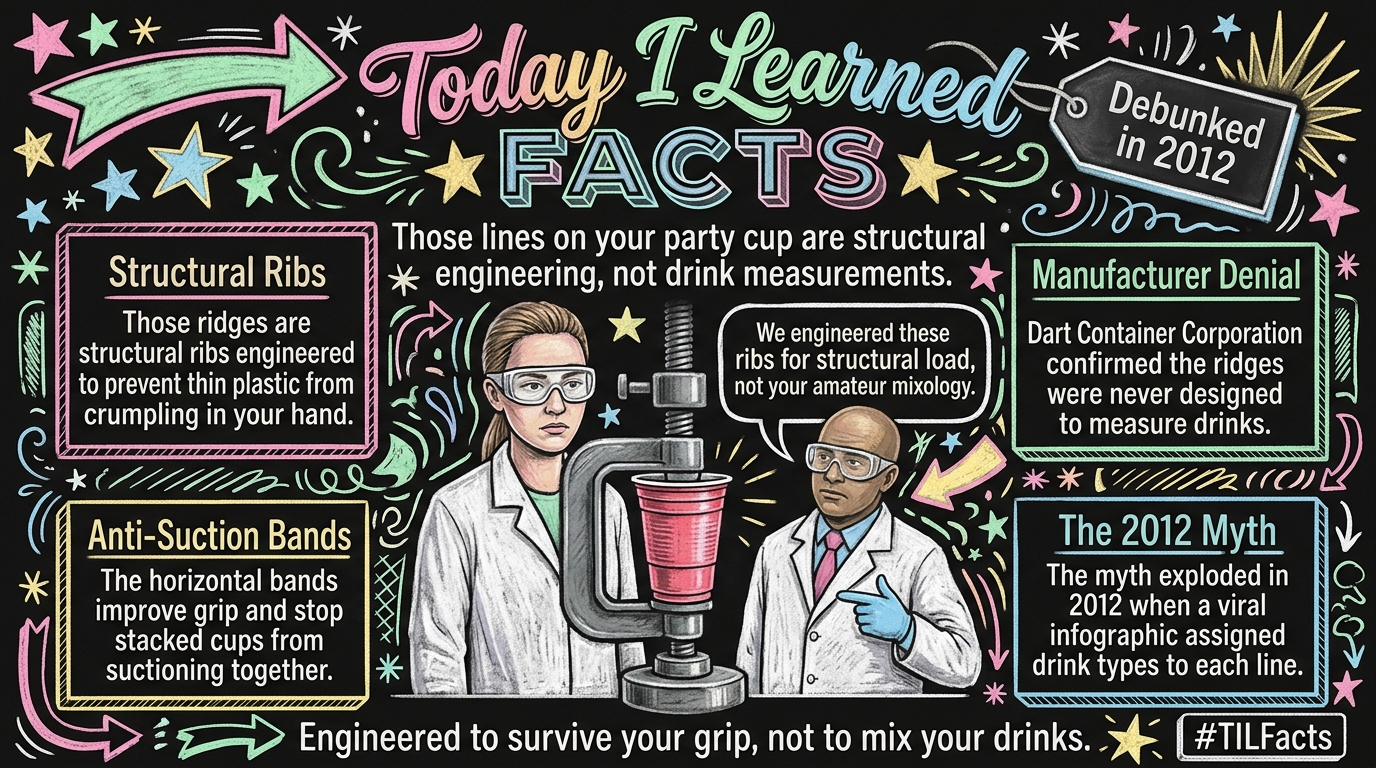
A viral graphic convinced millions that the ridges on a Red Solo cup were secret measurement lines for liquor, wine, and beer. Manufacturer Dart Container Corporation debunked the claim, stating the horizontal bands exist entirely for structural rigidity, stacking, and grip. Any matching volume is a pure coincidence of geometry.
Key Highlights
- 1The lines are structural ribs engineered to prevent thin plastic from collapsing.
- 2Dart Container Corporation confirmed the ridges were never designed to measure drinks.
- 3The horizontal bands improve grip and stop stacked cups from suctioning together.
- 4The myth exploded in 2012 when a viral infographic assigned drink types to each line.
The Deep Dive
The theory began circulating heavily around 2012 when an internet graphic assigned specific drinks to each horizontal band: one ounce for liquor at the bottom, five ounces for wine in the middle, and twelve ounces for beer near the top. The idea felt so intuitively clever that it instantly became accepted party lore.
In reality, plastic thermoforming requires stiffening ribs. Thin polystyrene collapses under the weight of liquid unless reinforced with geometry. The ridges distribute lateral stress, stop the cup from crushing in your fist, and provide friction when condensation builds up on the exterior.
Dart Container Corporation, which acquired the Solo Cup Company, has repeatedly stepped in to burst the bubble. The manufacturer confirmed that the tooling was designed for structural performance and mold release rather than calibrated barware accuracy.
While the lower line sits near an ounce and the upper line rests roughly around twelve, the interior taper makes them poor measuring tools. Liquid volume expands exponentially with height in a conical container, meaning eyeballing pours against unevenly spaced ridges yields wildly inconsistent servings.
Despite the manufacturer explicitly denying the urban legend, the measurement myth refuses to die. It turns out people simply prefer believing in an intentional secret bartender feature over the mundane reality of mechanical injection molding.
Discussion
No comments yet. Be the first to share what you found surprising.