
 Submit a TILF
TIL modern pianos have exactly 88 keys because any notes beyond that range fall outside the limits of human hearing and become mere rumblings or shrill clicks to our ears.
The sources below were found by search, checked to be reachable, and support this claim as stated.
Why do modern pianos have exactly 88 keys instead of a nice round number like 100?
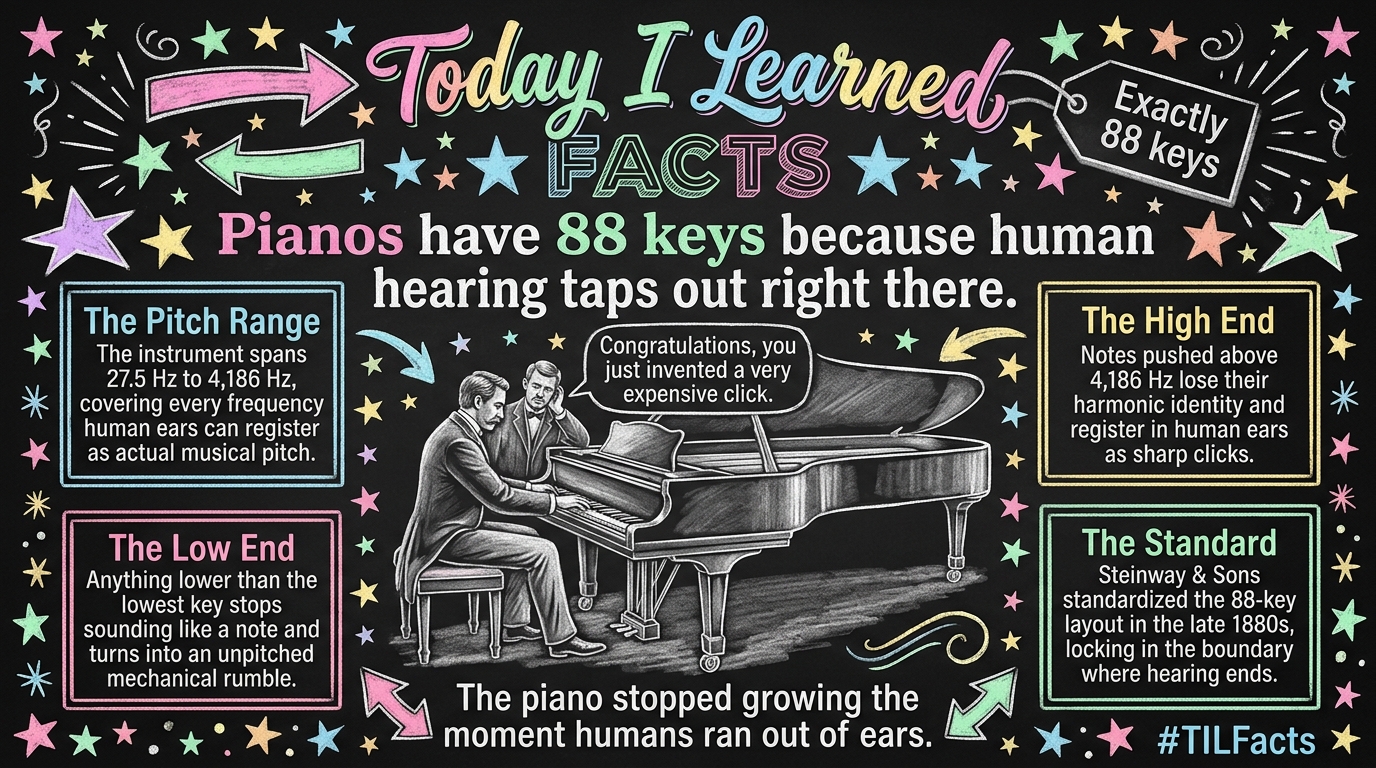
Modern pianos settle on exactly 88 keys not because 100 was too heavy, but because human hearing taps out. The standard range runs from A0 at 27.5 Hz up to C8 at 4,186 Hz. Any note lower sounds like an engine idling, and any note higher sounds like a dog whistle with no tune.
Key Highlights
- 1Pianos span 27.5 Hz to 4,186 Hz, mapping the exact limits of musical pitch.
- 2Notes below the 88-key span sound like unpitched mechanical rumbles.
- 3Notes above 4,186 Hz lose harmonic identity and register as sharp clicks.
- 4Steinway & Sons standardized the 88-key layout in the late 1880s.
The Deep Dive
Bartolomeo Cristofori invented the piano around 1700 with only 49 to 54 keys, borrowing the modest reach of the harpsichords before it. As classical composers demanded louder instruments and wider sonic palettes, manufacturers kept tacking on octaves. By the mid-19th century, makers had stretched the frame to 85 keys, chasing every scrap of dynamic range cast-iron frames could bear.
Steinway & Sons locked in the 88-key standard during the late 1880s, establishing the familiar seven octaves plus a minor third. Adding keys stopped being an engineering race and ran straight into acoustic biology. Sound frequencies outside this window stop registering as recognizable melody to the human brain, rendering extra notes musically useless.
At the low end, fundamental frequencies drop below 27.5 Hz. The ear stops hearing pitch and starts tracking individual shockwaves, perceiving the note as a rhythmic, percussive vibration rather than a musical tone. At the top end above 4,186 Hz, the human auditory system cannot reliably untangle pitch intervals, leaving listeners with shrill, unpitched clicks.
A few builders stubbornly build larger instruments anyway. The Bösendorfer Imperial 290 features 97 keys, extending the bass down to low C0. To prevent confused pianists from playing them by accident during normal performances, the extra sub-bass keys are often finished in solid black or tucked beneath a hinged flap.
Those sub-bass strings exist almost entirely to vibrate in sympathy when standard notes are struck, enriching the instrument's lower resonance. Building an eight-octave keyboard is trivial with modern steel, but composers do not write for it. The instrument did not stop expanding because wood ran out; it stopped because biology said enough.
Sources
Discussion
No comments yet. Be the first to share what you found surprising.