
 Submit a TILF
The word disaster literally translates to bad star, originating from the ancient belief that catastrophes were caused by unlucky planetary alignments.
The sources below were found by search, checked to be reachable, and support this claim as stated.
“disaster” basically means “bad star.” From Italian disastro, rooted in the belief that unfortunate celestial alignments caused terrible events. Ancient astrology walked so “Mercury is in retrograde” could run.
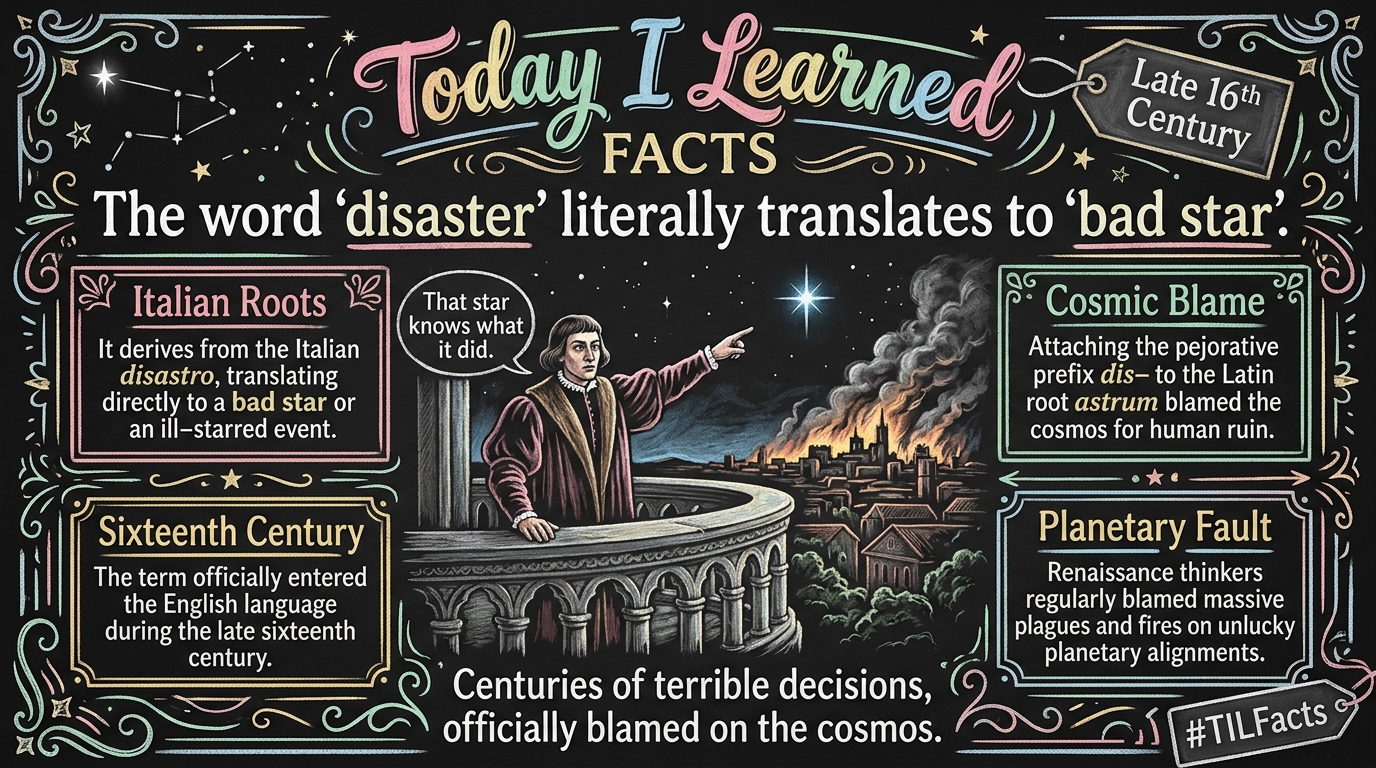
The word disaster comes straight from the Italian disastro, combining the pejorative prefix dis- with astro, meaning star. Renaissance Europe genuinely believed massive calamities were caused by unfortunate celestial alignments and spiteful planetary positions. Every time someone uses the word today, they are casually invoking sixteenth-century astrology.
Key Highlights
- 1Disaster derives from Italian disastro, meaning bad star or ill-starred event.
- 2The Latin root astrum paired with pejorative prefix dis- blamed the cosmos for ruin.
- 3The word entered the English language during the late sixteenth century.
- 4Renaissance thinkers regularly blamed plagues and fires on planetary alignments.
The Deep Dive
The word disaster entered the English language in the late sixteenth century as a direct borrowing through Middle French désastre and Italian disastro. At its base sits the Greek astron and Latin astrum, glued to a negative prefix. To the Renaissance mind, a disaster was not an abstract accident or a failure of logistics. It was an event dictated by an ill-starred sky, where the planets had lined up poorly and settled the matter before anyone on the ground had a say.
The underlying mechanism is classical astrology codified into standard vocabulary. Before modern astronomy split from astrological superstition, celestial movements were considered the primary driving force behind terrestrial fate. If a city burned, a plague arrived, or an armada sank, doctors and rulers routinely consulted star charts to identify which malevolent conjunction was responsible. Blaming the sky was the default explanatory framework of the era.
Lexicographers and etymological records, including the Oxford English Dictionary, thoroughly document this transition into English print. Early modern playwrights, notably William Shakespeare, leaned heavily on the astronomical weight of the term. In King Lear, the characters explicitly mock the common tendency to blame planetary influences and stellar alignments for human villainy and catastrophe, reflecting how ingrained the cosmic excuse had become.
Modern speakers often assume disaster has always been a general synonym for ruin, chaos, or natural tragedy. In reality, the word spent centuries as a precise technical term for astrological misfortune. When a harvest failed, people did not just observe bad weather; they diagnosed an unfavourable astral alignment. The cosmos was treated as an active participant with terrible timing.
Today, the astrological premise has vanished from the physical sciences, but the vocabulary never left. Modern secular life is full of fossilised superstitions hiding inside everyday administrative language. Whenever an emergency response team mobilises, they are operating under an official title that originally meant the stars were having a bad day.
Correction history
- August 20, 2026 — amended(Edited through the draft pipeline.)
Sources
Discussion
No comments yet. Be the first to share what you found surprising.