
 Submit a TILF
The Solar Eclipse That Ended a 6-Year War on the Spot
Credible sources disagree on this claim; both sides are presented below.
A total eclipse once ended a 6-year war on the spot. On May 28, 585 BCE, the Medes and the Lydians were locked in the sixth year of a brutal war in modern-day Turkey (the Battle of Halys). Midway through the clash, a sudden total solar eclipse turned the sky completely black. Both armies interpreted the midday darkness as a direct omen of divine anger, immediately laid down their weapons, ceased fighting, and negotiated a lasting peace treaty sealed by a double royal wedding. Greek historian Herodotus noted that astronomer Thales of Miletus had actually predicted the year the eclipse would occur.
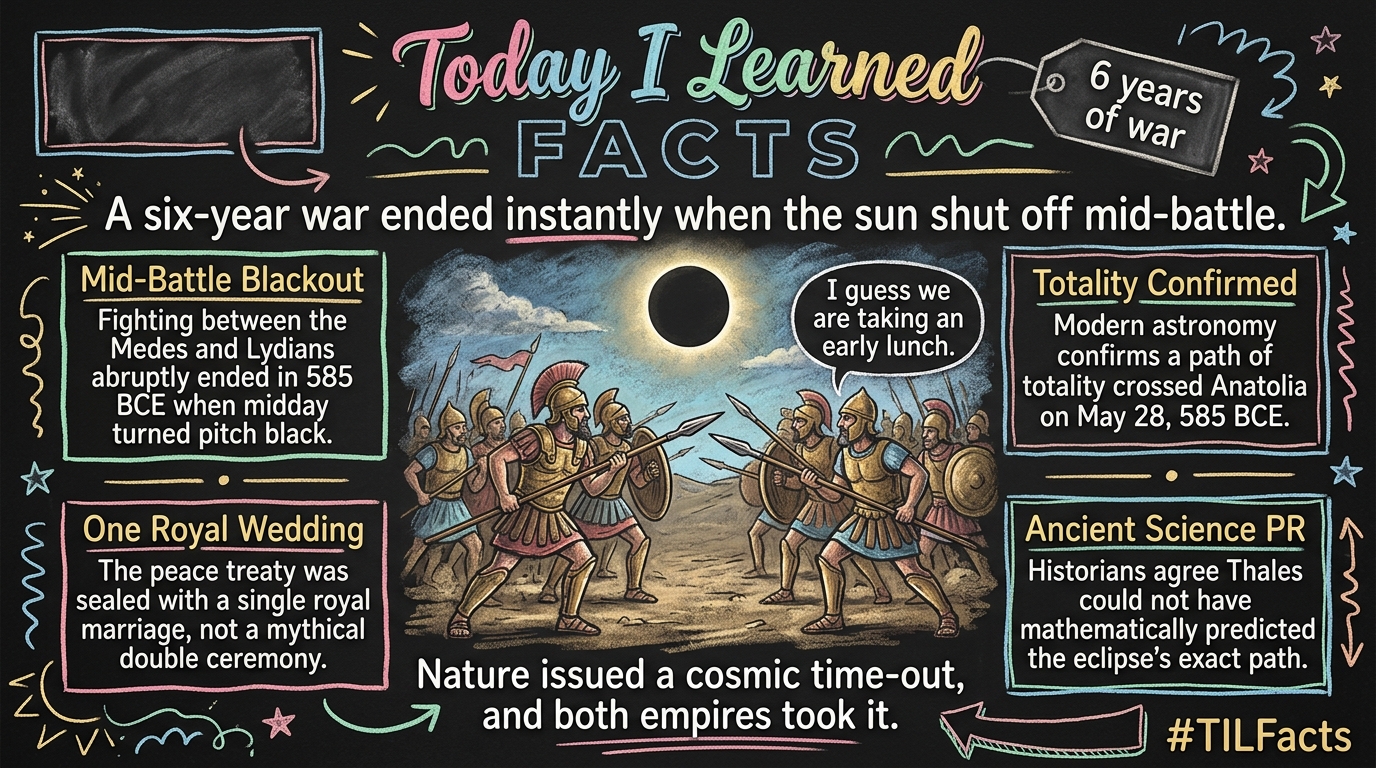
In 585 BCE, fighting between the Medes and Lydians ground to an immediate halt when midday turned into complete darkness. Both armies saw the solar eclipse as a direct order from above, dropped their weapons, and brokered peace through a royal marriage. The legend that Thales accurately predicted the exact day was added later by historians giving early science a victory lap.
Key Highlights
- 1A total solar eclipse abruptly ended combat between Medes and Lydians in 585 BCE.
- 2Modern astronomy confirms a path of totality crossed Anatolia on May 28, 585 BCE.
- 3The treaty was sealed with a single royal marriage, not a mythical double wedding.
- 4Historians agree Thales could not have mathematically predicted the eclipse path.
The Deep Dive
The Medes and Lydians had spent six grinding years fighting over dominance in Anatolia when celestial mechanics intervened on May 28, 585 BCE. According to Herodotus in Book 1 of his Histories, neither army held the upper hand until the sky went pitch black in the middle of combat. In an era where sudden celestial blackouts read as immediate divine displeasure, neither side felt like arguing with the universe.
Astronomical retrocalculations confirm that a path of totality swept directly across central Anatolia on that exact afternoon. Both commanders instantly ceased hostility, laid down their arms, and brought in neutral arbiters to arrange a binding settlement. The ensuing pact was secured not by military concessions, but by a diplomatic marriage between the Lydian princess Aryenis and the Median prince Astyages.
Herodotus famously wrote that the Greek philosopher Thales of Miletus had predicted the eclipse down to the year. That detail has fascinated chroniclers for millennia, but modern historians of ancient science point out a glaring problem. Sixth-century BCE astronomy had tracked broad lunar cycles, but predicting the exact geographic path of a total solar eclipse requires spherical geometry and orbital tracking methods that did not exist yet.
Later retellings also embellished the event with details Herodotus never wrote, such as dubbing the clash the Battle of Halys or claiming it ended with a flashy double wedding. The reality was a single, standard political marriage designed to glue a frontier together after an unsettling astronomical coincidence.
Even without a super-genius prediction, the 585 BCE eclipse remains one of the earliest historically anchored dates in antiquity. It is rare for a geopolitical crisis to end instantly because the sun decided to turn off, leaving both empires convinced that whatever they were fighting over was no longer worth the trouble.
Sources
Discussion
No comments yet. Be the first to share what you found surprising.