
 Submit a TILF
The real reason McDonald's ice cream machines are always broken led to a massive legal battle and a fight for the Right to Repair.
Credible sources disagree on this claim; both sides are presented below.
The McDonald’s Ice Cream Machine Lawsuit That Revealed A Secret High Tech Sabotage
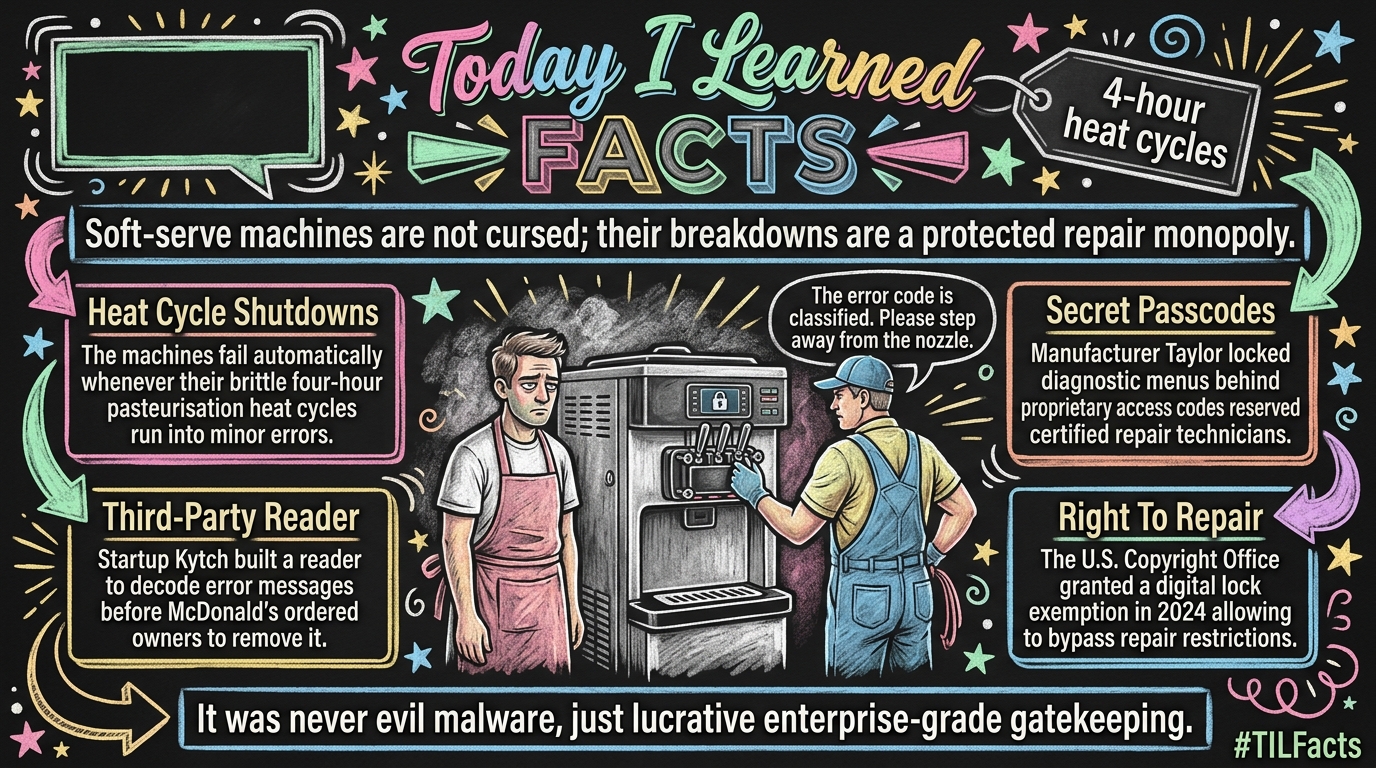
McDonald's soft-serve machines do not secretly sabotage themselves to spite hungry customers. Lawsuits between startup Kytch, manufacturer Taylor, and McDonald's revealed that the machines constantly shut down due to fragile daily heat cycles and proprietary software lockouts. Taylor and McDonald's coordinated to block independent diagnostic tools, preserving a lucrative repair monopoly rather than deploying secret self-destruct code.
Key Highlights
- 1The machines fail automatically during brittle four-hour pasteurisation heat cycles.
- 2Taylor locked diagnostic menus behind codes only certified repair techs could use.
- 3Startup Kytch built a reader to decode errors before McDonald's told owners to remove it.
- 4The U.S. Copyright Office granted a digital lock exemption for ice cream machines in 2024.
The Deep Dive
The legend of intentional corporate sabotage took off when a startup called Kytch invented a small gadget that decrypted the cryptic error menus of Taylor commercial soft-serve machines. Franchisees loved it because the machines routinely failed during mandatory four-hour heat-cleaning cycles, locking down entirely until an expensive certified Taylor technician showed up. Kytch gave restaurant managers the power to read error logs in plain English and fix minor issues like overfilling or temperature fluctuations on their own.
What looked like deliberate software sabotage was actually a masterclass in engineered maintenance dependency. Taylor machines operate on razor-thin mechanical tolerances, where slight deviations in liquid mix levels abort the pasteurisation cycle and lock the entire system. Instead of fixing the user interface, Taylor guarded access codes behind proprietary technician service menus, turning machine downtime into a massive recurring revenue stream.
Legal battles erupted when Kytch sued Taylor and McDonald's, alleging trade secret theft, defamation, and anti-competitive lockouts. Court filings showed Taylor obtained Kytch devices to reverse-engineer their features while McDonald's warned franchisees that third-party gadgets posed grave safety hazards. A federal judge even granted a temporary restraining order against Taylor, but the dispute centered on copyright restrictions and repair monopolies rather than planted digital malware.
Frustrated customers naturally assumed the machines were programmed to self-destruct on purpose. The truth is much more mundane and entirely about corporate control. The software did not maliciously brick machines; it simply refused to explain why it shut off, forcing store owners to pay authorized repair bills for routine resets.
The saga reached a tipping point when federal regulators stepped into the fast-food kitchen. In October 2024, the U.S. Copyright Office granted a crucial right-to-repair exemption, allowing restaurant owners to legally bypass digital locks on commercial soft-serve equipment. The war over fast-food ice cream was never about secret corporate sabotage, but it did expose how aggressive software licensing can keep an entire nation waiting for a McFlurry.
Discussion
No comments yet. Be the first to share what you found surprising.