
 Submit a TILF
The prestigious noble title Lord literally translates to bread guardian, originating from the Old English word hlaford meaning the keeper of the loaf.
The sources below were found by search, checked to be reachable, and support this claim as stated.
“Lord” basically meant “loaf-keeper.” Old English hlāford developed from a compound meaning the person responsible for guarding/providing bread. Feudalism: apparently just an extremely aggressive bakery hierarchy.
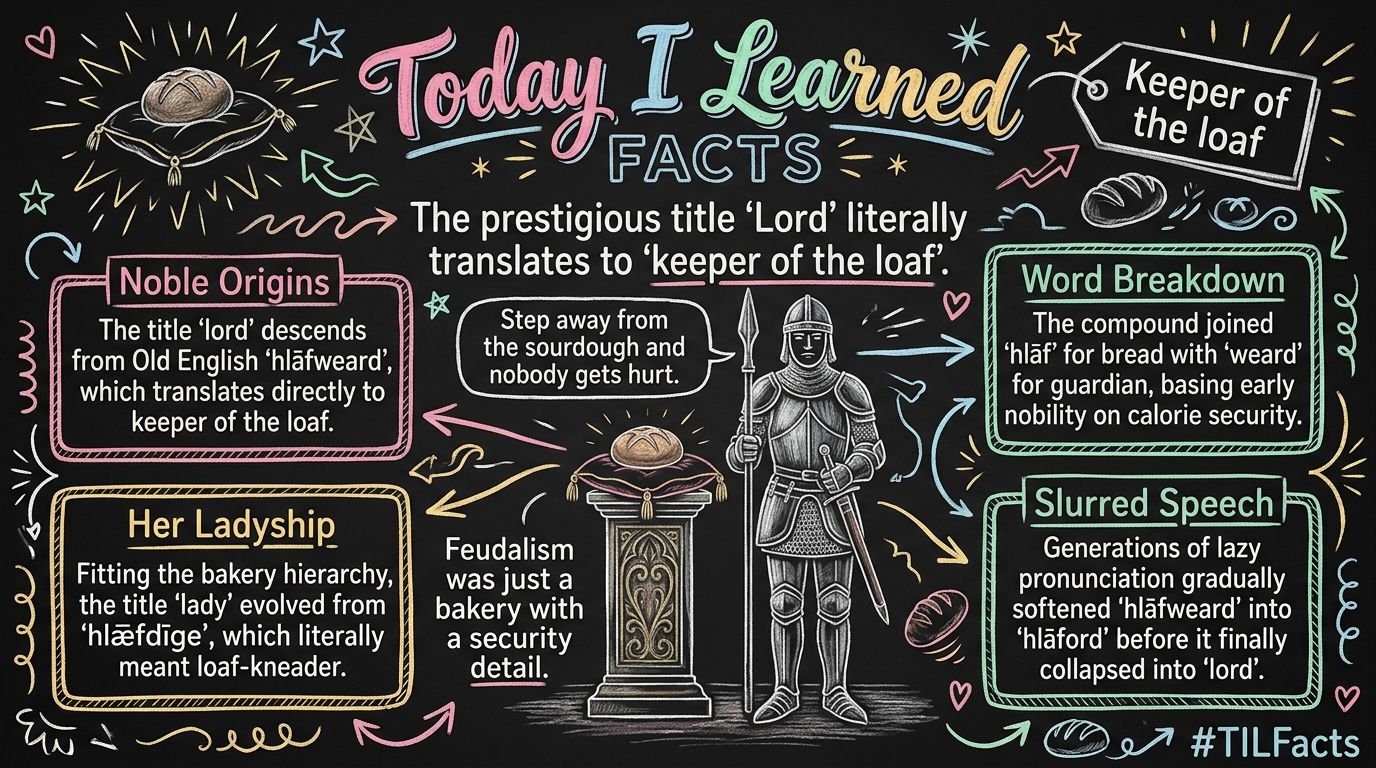
Before it meant castles and hereditary peerages, the title lord literally meant loaf-keeper. The word descends from the Old English hlāfweard, compounding hlāf (bread) and weard (guardian). Early medieval leadership was not about divine bloodlines; it was about who controlled the calories.
Key Highlights
- 1The word lord comes from Old English hlāfweard, meaning loaf-keeper.
- 2Old English hlāf meant bread and weard meant warden or guard.
- 3The title lady evolved from hlǣfdīge, meaning loaf-kneader.
- 4Generations of slurred speech turned hlāfweard into hlāford, then lord.
The Deep Dive
Long before aristocratic titles came with coats of arms and land deeds, Anglo-Saxon social standing operated on a remarkably transactional basis. The master of a household held authority because he possessed and protected the food supply. If you wanted to survive a northern European winter, you aligned yourself with the person guarding the grain stores.
Linguistically, the journey from carbohydrates to nobility is entirely direct. In Old English, hlāf meant bread or loaf, and weard meant a warden or guardian. Fused together, they formed hlāfweard, which over generations of daily speech softened into hlāford before Middle English compressed it into lord.
Historical linguistics recorded by the Middle English Compendium and the Online Etymology Dictionary documents this exact sound shift. As Germanic tribal bands evolved into feudal manors, the literal job description of guarding communal grain morphed into a general term for a ruler or master. The title expanded in prestige while shedding its culinary roots.
This naming convention was not an isolated quirk for men. The word lady underwent an almost identical culinary journey, descending from the Old English hlǣfdīge, which translates literally to loaf-kneader. The early English domestic hierarchy was explicitly structured around who made the bread and who guarded the storeroom door.
Modern institutions still preserve this medieval kitchen vocabulary with completely straight faces. The House of Lords, feudal land titles, and aristocratic honours are all etymological descendants of a chieftain making sure nobody stole his pantry stash.
Discussion
No comments yet. Be the first to share what you found surprising.