
 Submit a TILF
The most iconic weapon in sci-fi history was made from a discarded 1930s camera part bought for just 15 dollars.
The sources below were found by search, checked to be reachable, and support this claim as stated.
The Original Star Wars Lightsaber Was Actually a Camera Flash Tube
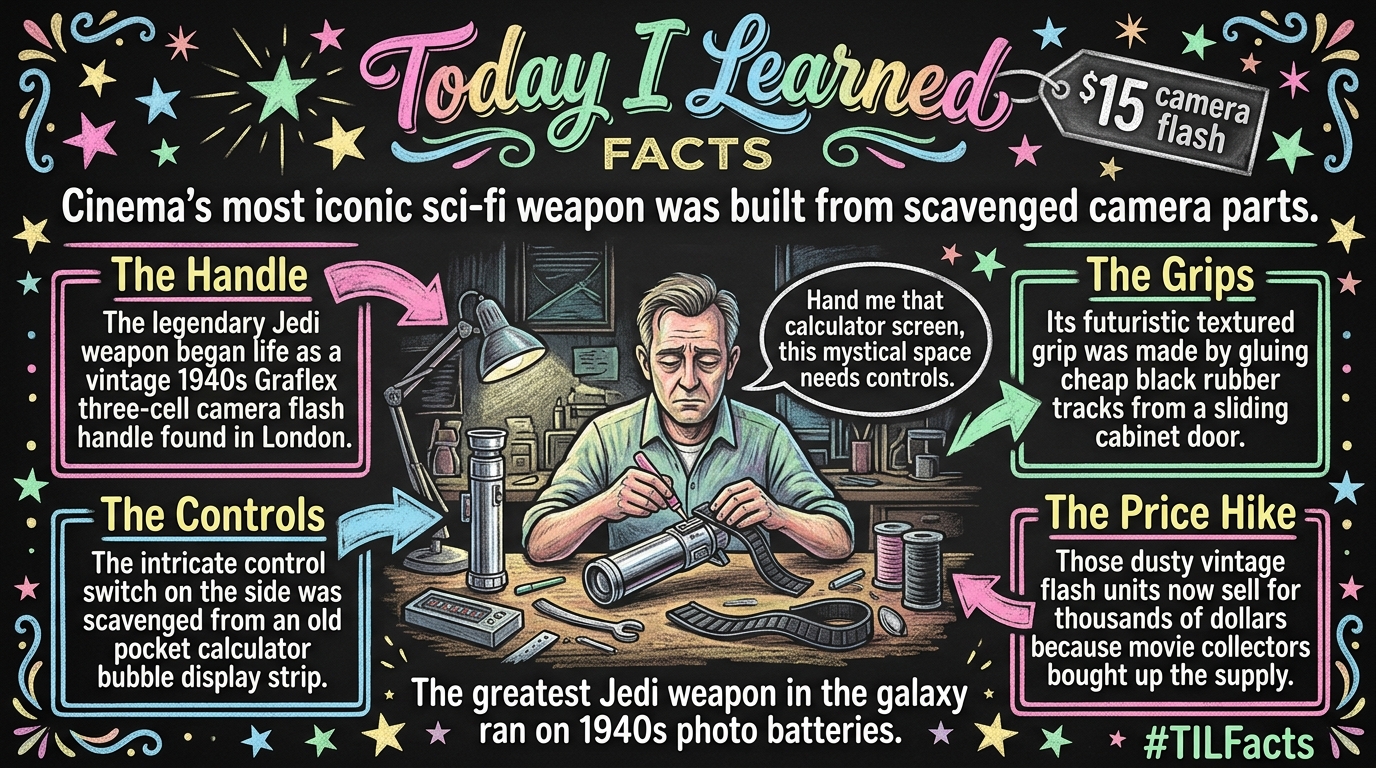
Luke Skywalker's original lightsaber was not a custom-machined sci-fi creation. Set decorator Roger Christian built the iconic weapon out of a vintage 1940s Graflex 3-cell camera flash handle he found in a dusty London photography shop. With some black cabinet sliding track glued on for grips and a pocket calculator lens strip, Christian created the most famous sword in cinema for practically zero budget.
Key Highlights
- 1Luke's original lightsaber hilt was a 1940s Graflex 3-cell camera flash tube.
- 2The black handgrips were made from cheap cabinet sliding-door rubber tracks.
- 3The control strip was scavenged from an old pocket calculator bubble display.
- 4Original Graflex flash units now cost thousands thanks to prop collectors.
The Deep Dive
During pre-production for the 1977 release of Star Wars, director George Lucas wanted a used, lived-in galaxy rather than pristine chrome spacecraft. The film had a notoriously tight prop budget, meaning custom-machined weapon hilts were out of the question. Set decorator Roger Christian had to improvise by hunting through vintage surplus shops across London for components with interesting mechanical silhouettes.
Christian visited a London camera shop where the owner pulled out dusty boxes containing surplus Graflex 3-cell flashguns from the 1940s. Press photographers had once mounted these heavy chrome tubes to Speed Graphic press cameras to hold flashbulbs and batteries. Christian saw an instant sci-fi hilt: the tube already featured a polished cylindrical body, a red firing button, and an industrial glass reflector clamp.
To turn the flash unit into a Jedi weapon, Christian added black T-track plastic strips salvaged from cabinet sliding doors to create a comfortable grip. He inserted a bubble lens strip scavenged from a vintage Texas Instruments pocket calculator into the clamp to mimic an electronic power readout. He screwed a picture-hanging D-ring to the bottom so actor Mark Hamill could hook the prop to his belt.
Fans often assume the lightsaber's distinct look came from high-concept concept art or industrial design blueprints. In reality, every detail on the hilt exists because a press photographer in the 1940s needed to trigger magnesium flashbulbs with their thumb. The original prop was literally assembled on a workbench with superglue and scrap rubber in an afternoon.
This DIY hardware philosophy became the foundation of modern sci-fi worldbuilding. Today, surviving vintage 1940s Graflex 3-cell flash units command thousands of dollars from collectors, not because vintage camera historians want them, but because Star Wars prop builders keep snapping up the supply to build screen-accurate replicas.
Discussion
No comments yet. Be the first to share what you found surprising.