
 Submit a TILF
The Eiffel Tower gains fifteen centimeters every summer simply by getting hot.
The sources below were found by search, checked to be reachable, and support this claim as stated.
The Eiffel Tower is about 15 centimeters taller in summer than in winter, because the iron expands in the heat.
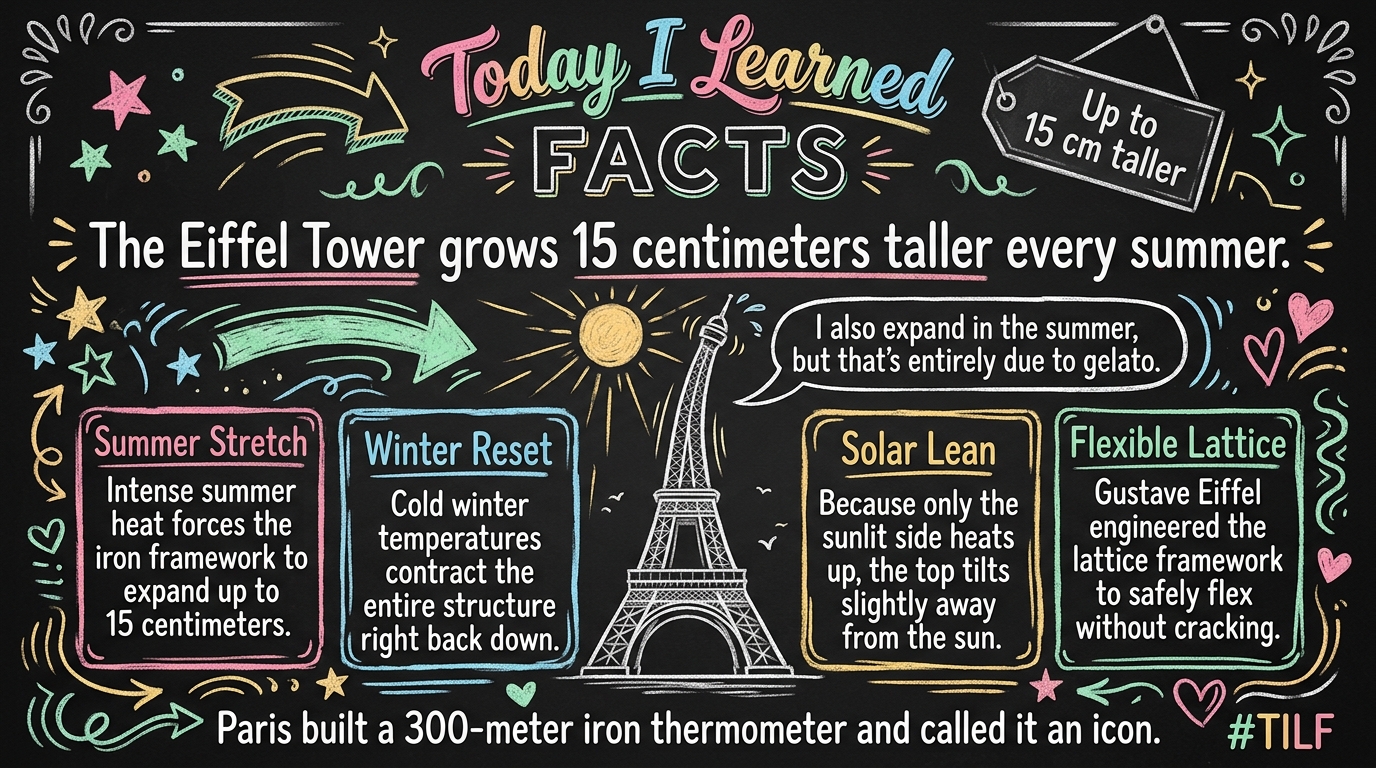
Summer heat adds about fifteen centimeters to the Eiffel Tower as seven thousand tonnes of puddle iron expand in the Paris sun. Thermal expansion forces the metal lattice outward, making the entire monument physically taller by July than it is in January. When the sun hits only one side, the heated beams push harder than the shaded ones, causing the summit to tilt away from the light.
Key Highlights
- 1The Eiffel Tower gains about 15 centimeters of height during hot summer months.
- 2Thermal expansion pushes the iron atoms apart across 300 meters of lattice.
- 3Uneven sunlight on the beams causes the tower summit to tilt away from the heat.
- 4In freezing winter conditions, the contracted iron shrinks the monument back down.
The Deep Dive
Gustave Eiffel built a three-hundred-metre iron spire for the 1889 World's Fair, but he did not build a rigid statue. He built a giant thermometer. Every June, as temperatures rise across the Champ de Mars, the Eiffel Tower quietly stretches up to fifteen centimetres taller than its winter baseline. Visitors climbing the stairs in July stand on a monument that is physically larger than the one photographed in December.
The growth is pure physics. The tower is held together by roughly two and a half million rivets securing over seven thousand tonnes of puddle iron. When ambient temperatures climb, thermal energy excites the iron atoms, pushing them further apart and expanding every girder by a fraction of a millimetre. Multiplied across three hundred metres of open lattice, those microscopic shifts stack up into a noticeable vertical surge.
Engineers at the monument track these dimensional shifts constantly. Sensors and laser measurements show that the expansion is not just vertical. When morning sunlight cooks the southern and eastern faces while the northern beams remain cool, the uneven expansion forces the tip of the tower into a subtle curve. Over a scorching day, the summit traces an elliptical wobble of up to eighteen centimetres, physically leaning away from the sun to keep its structural balance.
People often imagine that expanding metal threatens to buckle the frame or pop the rivets loose. In reality, Eiffel calculated thermal movement into the blueprint before workers turned a single bolt. The intricate criss-cross lattice was engineered to breathe, absorbing seasonal expansion and wind deflection without stressing the stone foundation blocks. Cold snaps do the exact reverse, shrinking the girders so the tower drops a few centimetres below its nominal height.
This seasonal pulse makes fixing a permanent official height impossible. Modern antennas have raised the official figure past three hundred and thirty metres, but nature still edits the exact number on an hourly basis. Any rigid skyscraper would tear itself apart under similar temperature swings, yet Paris's most famous landmark handles the weather by casually warping in place every afternoon.
Discussion
No comments yet. Be the first to share what you found surprising.