
 Submit a TILF
Sharks had a hundred-million-year head start on trees.
Well supported by the sources below, with a detail a reviewer flagged as worth reading in context.
Sharks are older than trees. The first sharks were swimming roughly 100 million years before anything on land had grown into a tree.
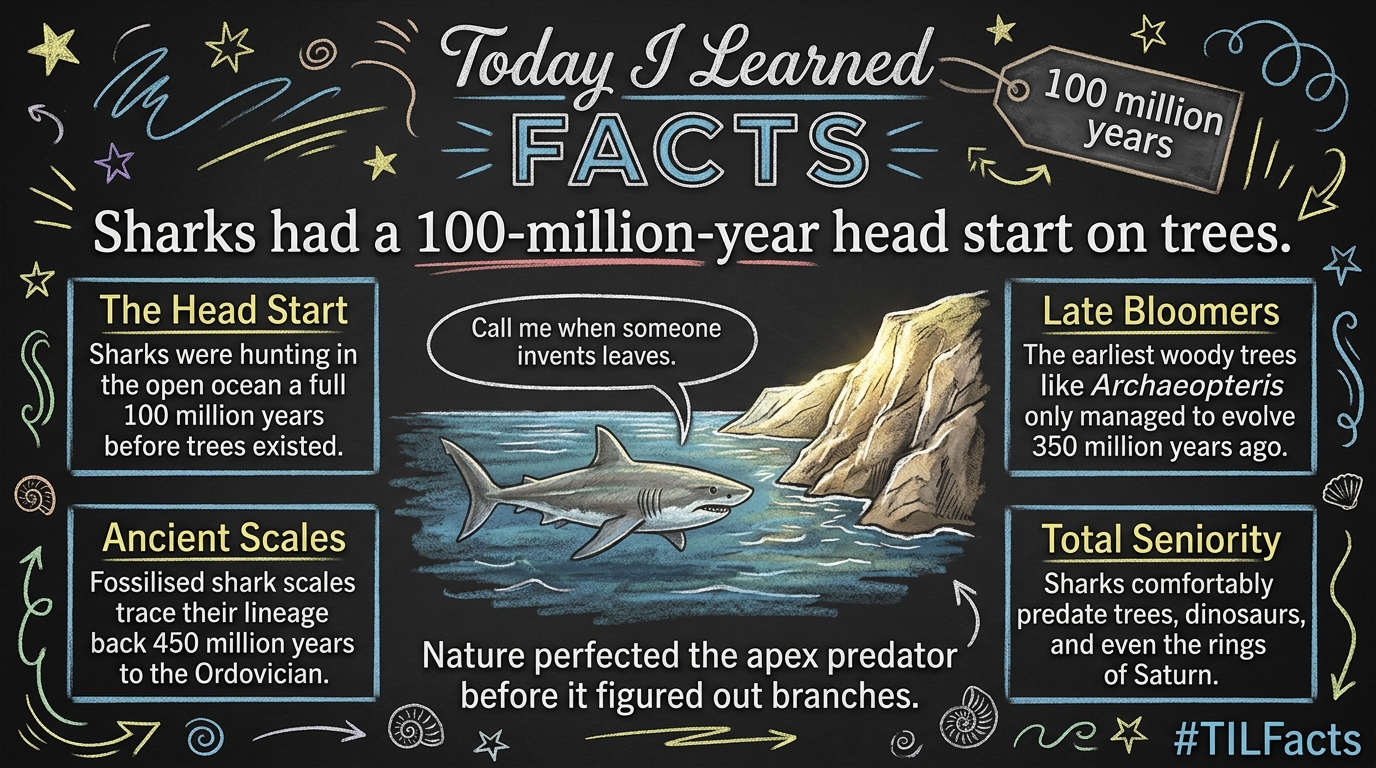
The earliest shark scales appear in the fossil record 450 million years ago, while the first woody trees did not evolve until around 350 million years ago. Sharks spent roughly 100 million years patrolling ocean currents before a single seed sprouted on dry land. By the time the first forest cast shade, sharks had already survived an entire geological era without needing bark, leaves, or soil.
Key Highlights
- 1Sharks were hunting in the ocean 100 million years before trees existed.
- 2Fossilised shark scales date back 450 million years to the Ordovician.
- 3The earliest woody trees like Archaeopteris only appeared 350 million years ago.
- 4Sharks are older than trees, dinosaurs, and even the rings of Saturn.
The Deep Dive
Every mental timeline of the planet puts plants on land before terrifying apex predators, because building an ecosystem usually requires dirt before carnivores. Earth ran the schedule backwards. The earliest fossil evidence of sharks dates back roughly 450 million years to the Late Ordovician, when ocean life was already thriving. Land at the time was essentially bare rock, damp mud, and primitive mosses. Nothing on the continents stood taller than a few inches.
Growing a tree requires solving serious mechanical engineering problems, starting with lignin. Plants had to invent rigid vascular systems to pump water against gravity and stay upright in open air, a structural breakthrough that took plants until the Devonian period around 350 million years ago. Sharks avoided the entire gravity debate by staying buoyant in salt water. Their secret was flexible cartilage instead of heavy bone, paired with hydrodynamic dermal denticles that reduced drag. They perfected an apex body plan while plants were still figuring out how to stand up.
The timeline is anchored in physical geology. Palaeontologists in Siberia and North America have recovered fossilised shark-like scales dating to approximately 450 million years ago, followed by undisputed shark teeth from the Early Devonian around 410 million years ago. Meanwhile, the oldest known trunk-forming progymnosperm, Archaeopteris, only shows up in the fossil record around 350 to 385 million years ago. That leaves a clean hundred-million-year gap where sharks were hunting in mature marine food webs while the continents were completely bare of timber.
Popular culture treats sharks as relics of the dinosaur age, but that understates their age by two whole centuries of millions of years. Dinosaurs did not show up until about 230 million years ago, making sharks more than 200 million years older than Tyrannosaurus rex. People also assume trees are ancient fixtures of nature rather than a relatively late evolutionary experiment. For the first 100 million years of shark history, nothing on the planet dropped an autumn leaf, dropped an acorn, or caught fire in a forest fire, because wood simply did not exist.
Having a hundred-million-year head start gave sharks enough evolutionary runway to survive four of the planet's 'Big Five' mass extinction events, including the catastrophic Permian-Triassic wipeout that killed 96% of all marine species. They outlasted trilobites, ammonites, and every dinosaur, only to encounter modern industrial fishing fleets that harvest over 70 million sharks a year. Surviving five planetary resets was easy; sharing an ocean with the primates who learned to cut down trees is proving considerably harder.
Discussion
No comments yet. Be the first to share what you found surprising.