
 Submit a TILF
On Venus, a single day lasts longer than an entire year because it takes 243 Earth days to complete one rotation on its axis but only 225 Earth days to orbit the Sun.
Credible sources disagree on this claim; both sides are presented below.
A day on Venus is longer than a year on Venus. It takes about 243 Earth days to turn once on its axis and about 225 to go round the Sun.
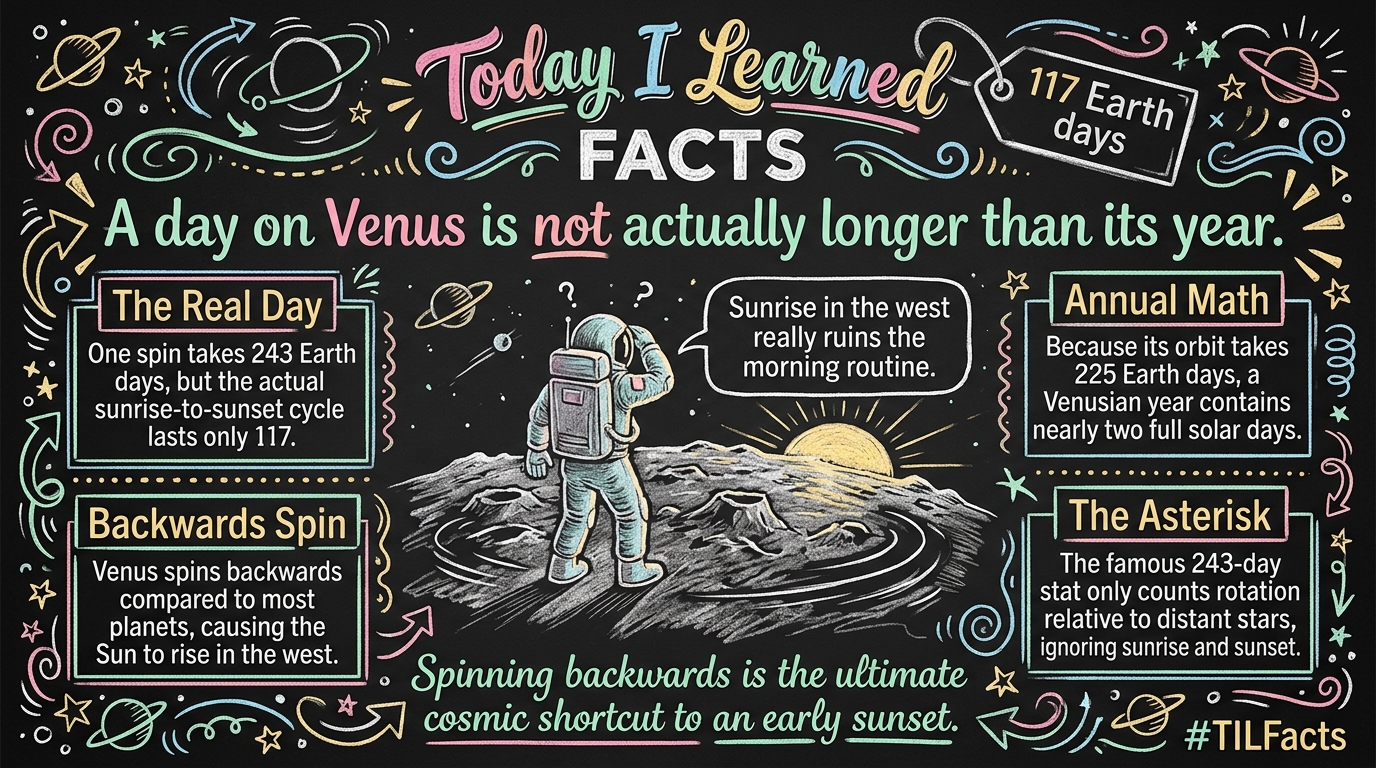
Venus rotates so slowly that one full spin takes 243 Earth days, which is indeed longer than its 225-day trip around the Sun. But because Venus spins backwards, the actual cycle from sunrise to sunrise takes just 117 Earth days. One Venusian year contains almost two entire solar days.
Key Highlights
- 1Venus takes 243 Earth days to spin once, but its solar day is only 117 Earth days.
- 2Venus orbits the Sun in 225 Earth days, fitting nearly two solar days per year.
- 3Venus spins backwards compared to most planets, causing the Sun to rise in the west.
- 4The 243-day figure only counts spin relative to stars, not sunrise to sunset.
The Deep Dive
Planetary trivia loves to claim that a day on Venus outlasts its year. That claim rests on an axial spin lasting roughly 243 Earth days alongside an orbital journey around the Sun of about 225 Earth days. Taken purely as an isolated spin against distant background stars, the rotation is slower than the orbit.
The catch is how day-to-day time actually works on a planet. Astronomers separate a sidereal day, which is one pure 360-degree rotation, from a solar day, which measures the interval between two successive noons. Because Venus orbits the Sun while rotating backwards compared to most planets in our solar system, its orbital movement accelerates the progression of the Sun across its sky.
Measurements compiled by NASA and JAXA show that this retrograde spin compresses the day-night cycle dramatically. Instead of dragging on for 243 Earth days, a full solar day on Venus wraps up in approximately 117 Earth days. An observer standing on the scorching surface would watch the Sun rise in the west and set in the east in less than half of a Venusian year.
The widespread confusion comes from treating the sidereal rotation as the functional definition of a day. On Earth, the difference between a sidereal day and a solar day is only about four minutes, making the distinction negligible in everyday life. On Venus, backwards rotation turns that subtle difference into a massive 126-day gap between spin time and sunlight cycles.
This counter-intuitive geometry means a Venusian calendar is bizarrely paced. A single year on Venus spans just under two complete solar days. The planet manages to have a rotation slower than its year while simultaneously squeezing two full daylight cycles into every orbit.
Sources
Discussion
No comments yet. Be the first to share what you found surprising.