
 Submit a TILF
In the 1960s, the CIA spent millions on Operation Acoustic Kitty to turn real domestic cats into covert listening devices.
The sources below were found by search, checked to be reachable, and support this claim as stated.
The 1960s CIA Project That Tried Turning House Cats Into Spies
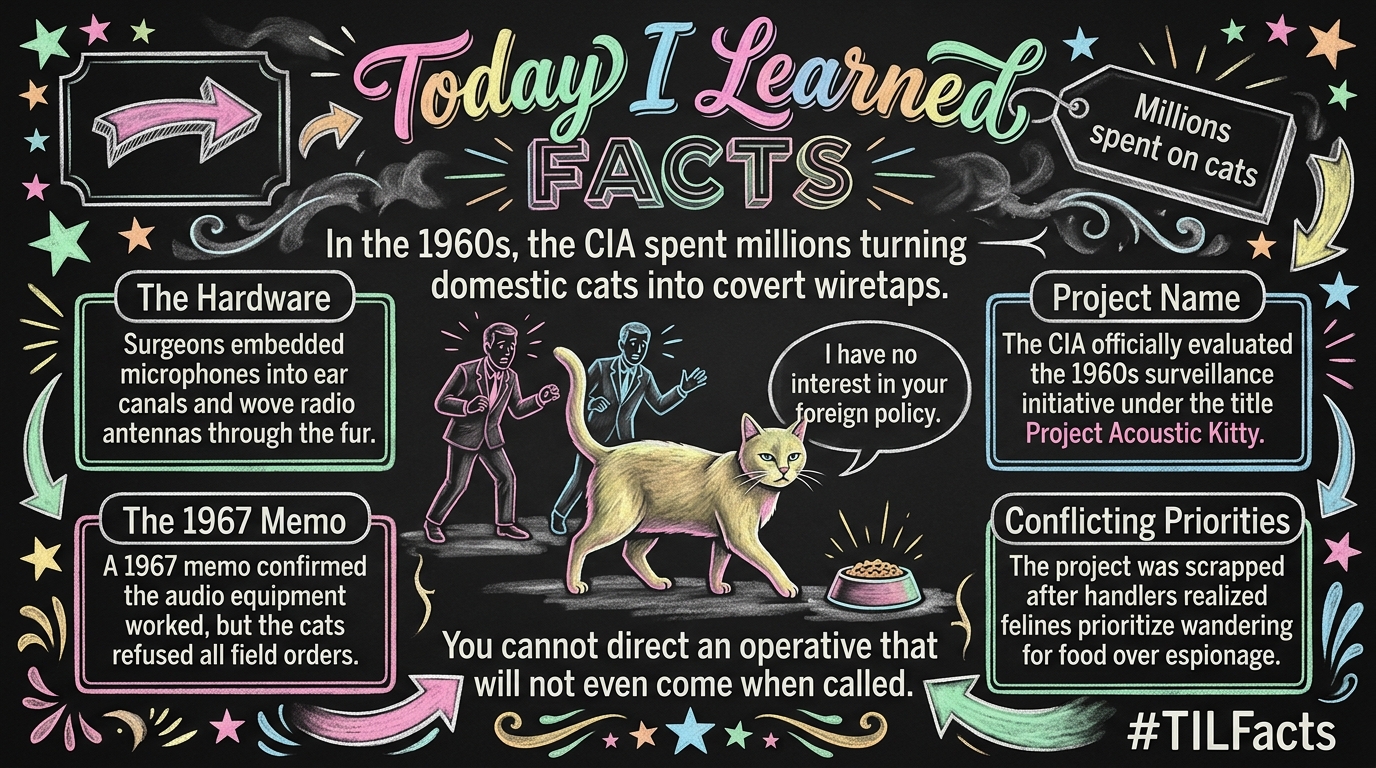
During the 1960s, the CIA launched Project Acoustic Kitty to turn domestic cats into covert mobile wiretaps. Veterinary surgeons embedded microphones in their ear canals, transmitters at the base of their skulls, and wire antennas woven through their fur. The project was scrapped after the CIA realised that cats are fundamentally uninterested in national security.
Key Highlights
- 1Surgeons placed a microphone in the ear and an antenna woven through the fur.
- 2The 1960s effort was officially evaluated by the CIA as Project Acoustic Kitty.
- 3A 1967 memo confirmed the tech worked but the cats refused to follow field orders.
- 4The program was cancelled after realizing felines prioritize food over espionage.
The Deep Dive
During the height of the Cold War, the CIA Directorate of Science and Technology tackled a persistent espionage problem: audio surveillance bugs work best when someone puts them right beside the target, but human agents draw immediate attention. Their proposed solution bypassed human couriers entirely. Domestic cats (*Felis catus*) naturally wander around embassies, gardens, and park benches without raising suspicion. To intelligence planners, a cat looked like an inconspicuous furry chassis for an eavesdropping transmitter.
The resulting surgical initiative, dubbed Project Acoustic Kitty, took years of delicate biological engineering. Surgeons placed a miniature microphone inside the animal's ear canal, nestled a small radio transmitter at the base of the skull, and ran a thin wire antenna along the spine and through the fur to the tail. The entire rig had to remain invisible from the outside while keeping the animal mobile and alive.
Declassified documents, including a heavily redacted March 1967 evaluation memo titled 'Views on Trained Cats,' confirm that the agency successfully built the hardware. The technical milestone proved that surgeons could equip a mammal with concealed broadcast technology. The agency even praised the researchers for their pioneering biomedical craft, noting that a cat could indeed be trained to cover short distances under controlled conditions.
A popular legend insists the very first field-tested cat was immediately struck and killed by a taxi in Washington, D.C. Former intelligence personnel later disputed that fatal urban myth, clarifying that the test was called off because the animals simply wandered off whenever they smelled food, encountered distractions, or felt uncooperative. The fundamental flaw was behavioral rather than vehicular.
The 1967 memo closed the book on the experiment, dryly concluding that practical environmental factors made feline surveillance unviable for specialized intelligence work. The CIA spent significant funds and surgical effort only to discover what every pet owner already knew: you cannot instruct a cat to care about foreign policy.
Sources
Discussion
No comments yet. Be the first to share what you found surprising.