
 Submit a TILF
How Einstein's Theory of Relativity Prevents Your Phone's GPS From Drifting Miles Off Course Every Day
The sources below were found by search, checked to be reachable, and support this claim as stated.
Why Your GPS Would Fail If Scientists Didn't Account For Time Dilation
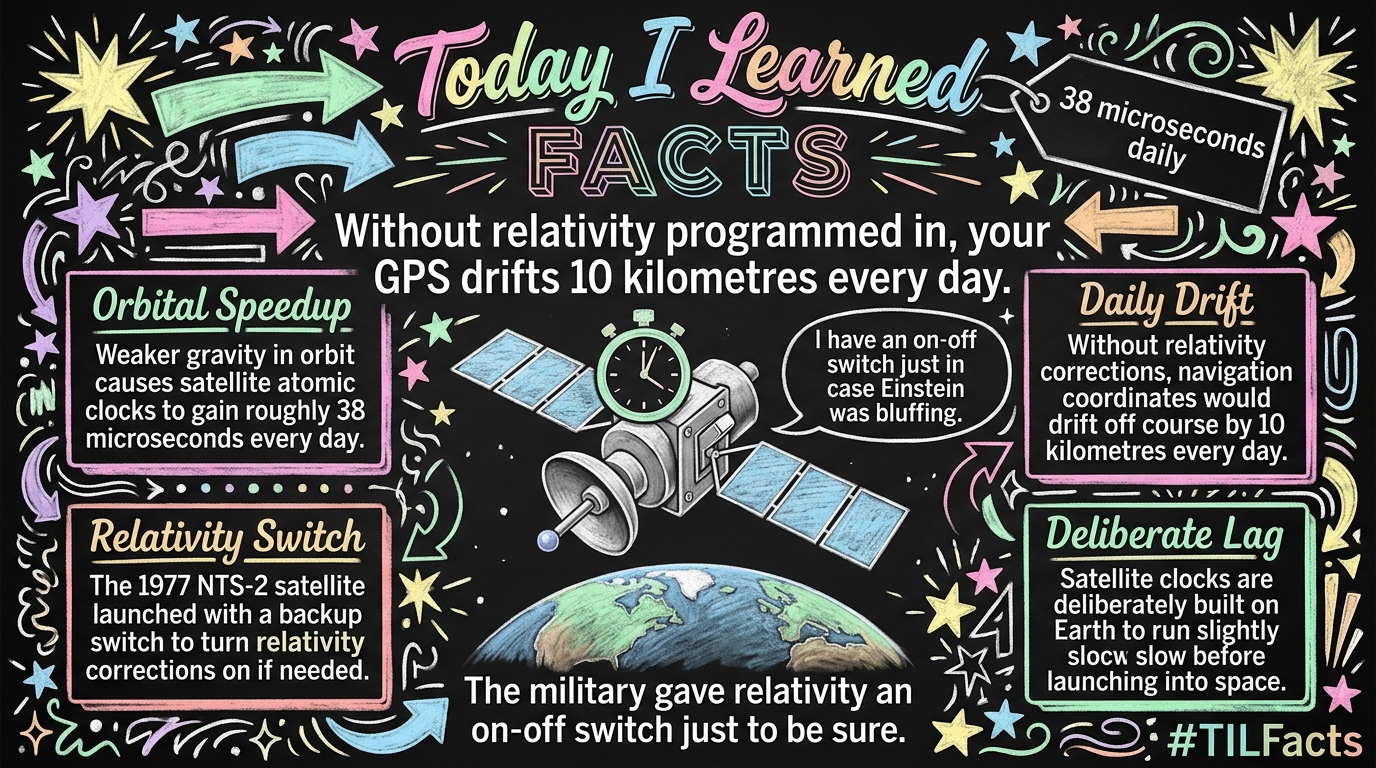
GPS satellites run on atomic clocks that tick faster than identical clocks on the ground. Weak gravity in orbit speeds them up, while their orbital speed slows them down, leaving a net gain of roughly 38 microseconds every day. Without compensating for Einstein's theories of relativity, navigation apps would drift by about 10 kilometres every 24 hours.
Key Highlights
- 1Satellites gain about 38 microseconds daily due to weaker orbital gravity.
- 2Without relativity fixes, GPS coordinates drift by 10 kilometres per day.
- 3The 1977 NTS-2 satellite carried a backup switch to turn relativity corrections on.
- 4Satellite clocks are deliberately built on Earth to run slightly too slow.
The Deep Dive
Satellite navigation is fundamentally an exercise in hyper-precise timekeeping. A GPS receiver pinpoints location on Earth by measuring exactly how long radio signals take to arrive from multiple satellites travelling at the speed of light. Because light covers roughly 30 centimetres in a single nanosecond, an error of a few millionths of a second ruins the geometry.
Two competing relativistic effects distort satellite time simultaneously. Albert Einstein's special relativity dictates that moving clocks tick slower, which shaves about 7 microseconds off orbital clocks each day due to their speed. Simultaneously, general relativity dictates that clocks in weaker gravitational fields tick faster, adding roughly 45 microseconds per day at an altitude of 20,000 kilometres. Combine the two, and satellite clocks run fast by around 38 microseconds every single day.
Engineers confirmed this reality in June 1977 during the launch of the NTS-2 test satellite. Skeptical military designers built in a switch to turn relativistic frequency corrections on or off, just in case theoretical physics proved impractical. Once in orbit, the uncorrected clock drifted exactly as predicted, prompting engineers to permanently flip the switch to activate the relativistic offset.
Today, engineers solve the problem before the hardware leaves the launchpad. The crystal oscillators inside satellite atomic clocks are intentionally tuned on Earth to run slightly slow at 10.22999999543 MHz instead of their nominal 10.23 MHz. Once deployed in orbit, gravitational time dilation accelerates them back up to match terrestrial frequencies seamlessly.
If navigation networks ignored relativistic mechanics, position tracking would degrade by roughly 10 to 11 kilometres every single day. Within two minutes of operation, turn-by-turn navigation would fail to identify the correct street. Modern infrastructure relies entirely on theoretical physics conceived decades before the space age began.
Sources
Discussion
No comments yet. Be the first to share what you found surprising.