
 Submit a TILF
From Hot Air to Fish Scales: How NASCAR & Indy's Weirdest Starts Made Racing History
The sources below were found by search, checked to be reachable, and support this claim as stated.
Before American motorsport became synonymous with high-tech precision, the sport's early years relied on pure improvisation, whether that meant launching the very first race at the Indianapolis Motor Speedway with zero cars as a nine-team gas balloon contest, or settling an official NASCAR engine protest by carrying a greasy, race-winning flywheel to a local fish market to weigh it on their scale.
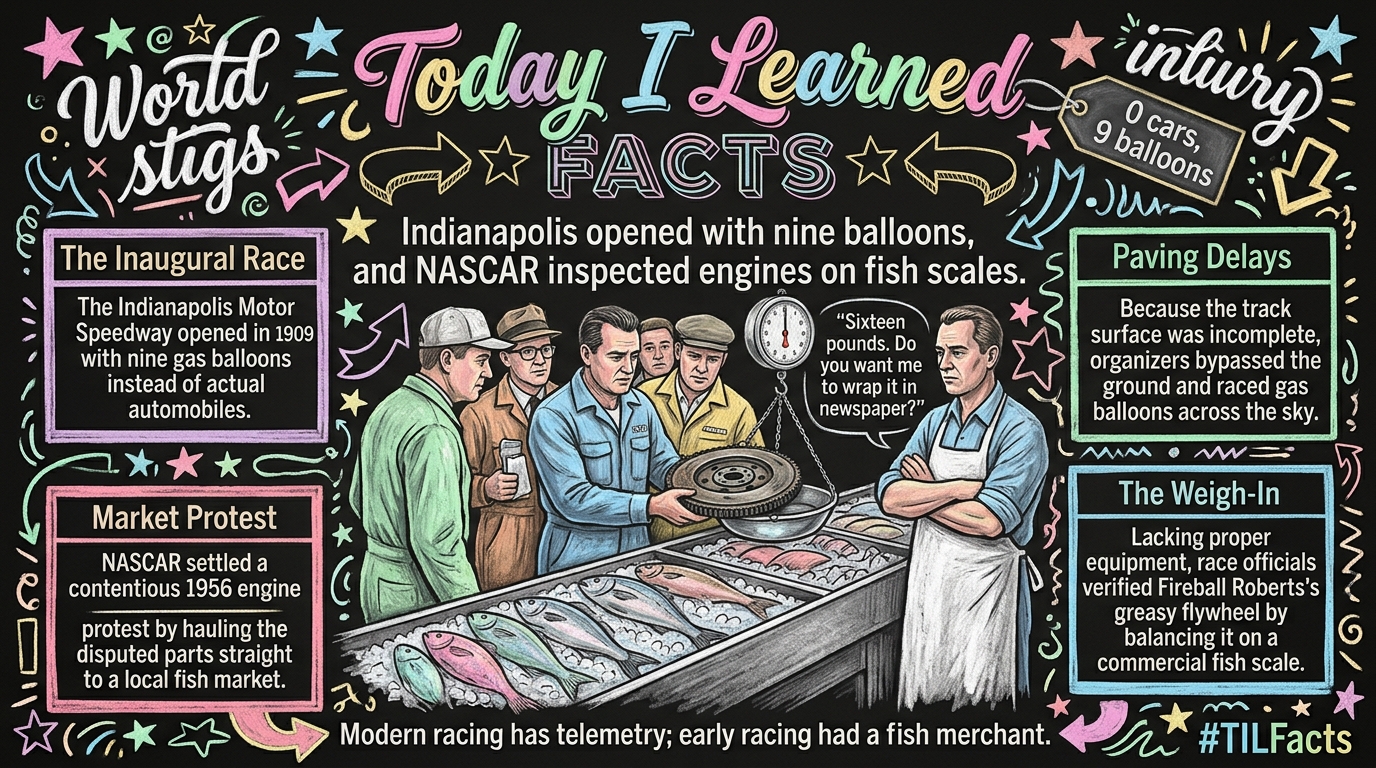
Before American motorsport engineered every fraction of a second, early racing ran on frantic improvisation. The world's most famous auto racetrack held its very first competition without a single car, opting for nine hot air balloons because the track surface was still unfinished. Decades later, NASCAR settled a contentious engine protest by hauling a winner's greasy flywheel to a local fish market to use their commercial scale.
Key Highlights
- 1The Indianapolis Motor Speedway opened in 1909 with a nine-balloon contest, not cars.
- 2The track surface was incomplete, so organizers raced gas balloons across the sky.
- 3In 1956, NASCAR inspectors settled an engine protest by visiting a local fish market.
- 4Officials lacked equipment, weighing Fireball Roberts's flywheel on a fish scale.
The Deep Dive
When Carl Fisher founded the Indianapolis Motor Speedway, his vision was a world-class automotive proving ground. On June 5, 1909, the gates opened to forty thousand spectators, but not one engine fired up. The crushed-stone track was far from ready, leaving organizers with a vast open venue and thousands of ticket holders. Their solution was to launch the National Championship Gas Balloon Race, floating nine massive balloon crews over Indiana instead of running cars.
Early stock car racing operated with similarly scrappy resourcefulness. NASCAR in the 1950s was a bare-knuckle contest between moonshine runners, factory engineers, and rulebook exploiters. Technical inspection was rarely an exact science, often coming down to whatever measuring tape or mechanical gauge the chief steward had in his pocket.
Following the July 4, 1956 Grand National race at Raleigh Speedway, driver Fireball Roberts took the checkered flag, but competitors immediately protested his engine. Rivals claimed his crew had illegally shaved down the flywheel to reduce rotational mass and gain a rapid acceleration edge. NASCAR officials pulled the engine apart on the spot, only to realise they lacked a precision scale capable of verifying the part's legal minimum weight.
Modern race fans assume early motorsport arrived fully formed with governing bodies, high-tech telemetry, and airtight telemetry. The reality was a scramble of trial and error where organizers wrote procedure on the fly. Track officials did not have laboratory equipment stationed in the paddock, so they solved problems using ordinary downtown retail infrastructure.
The NASCAR inspectors walked the greasy, protested flywheel down the street to a nearby Raleigh fish market. Slapping the heavy engine component directly onto the merchant's certified commercial seafood scale, they checked the reading against factory specifications to confirm it was legal. Motorsport history is not just aerodynamic wind tunnels; it is balloon launches and seafood counters.
Sources
Discussion
No comments yet. Be the first to share what you found surprising.