
 Submit a TILF
Did UFC Almost Have a Shark Moat? The True Story
Credible sources disagree on this claim; both sides are presented below.
The Original Fight Arena Almost Had a Moat with Live Alligators and Sharks When UFC co-founder Rorion Gracie and television producer Campbell McLaren were brainstorming concepts for UFC 1 in 1993, they wanted a visual design that emphasized total confinement and spectacle. Early pitches included surrounding the fighting canvas with an electrified wire fence, a ring of fire, or a water moat stocked with live alligators or sharks. After realizing the immense logistical hazards and legal liabilities of wild animals, Hollywood art director Jason Cusson designed the iconic Octagon cage instead.
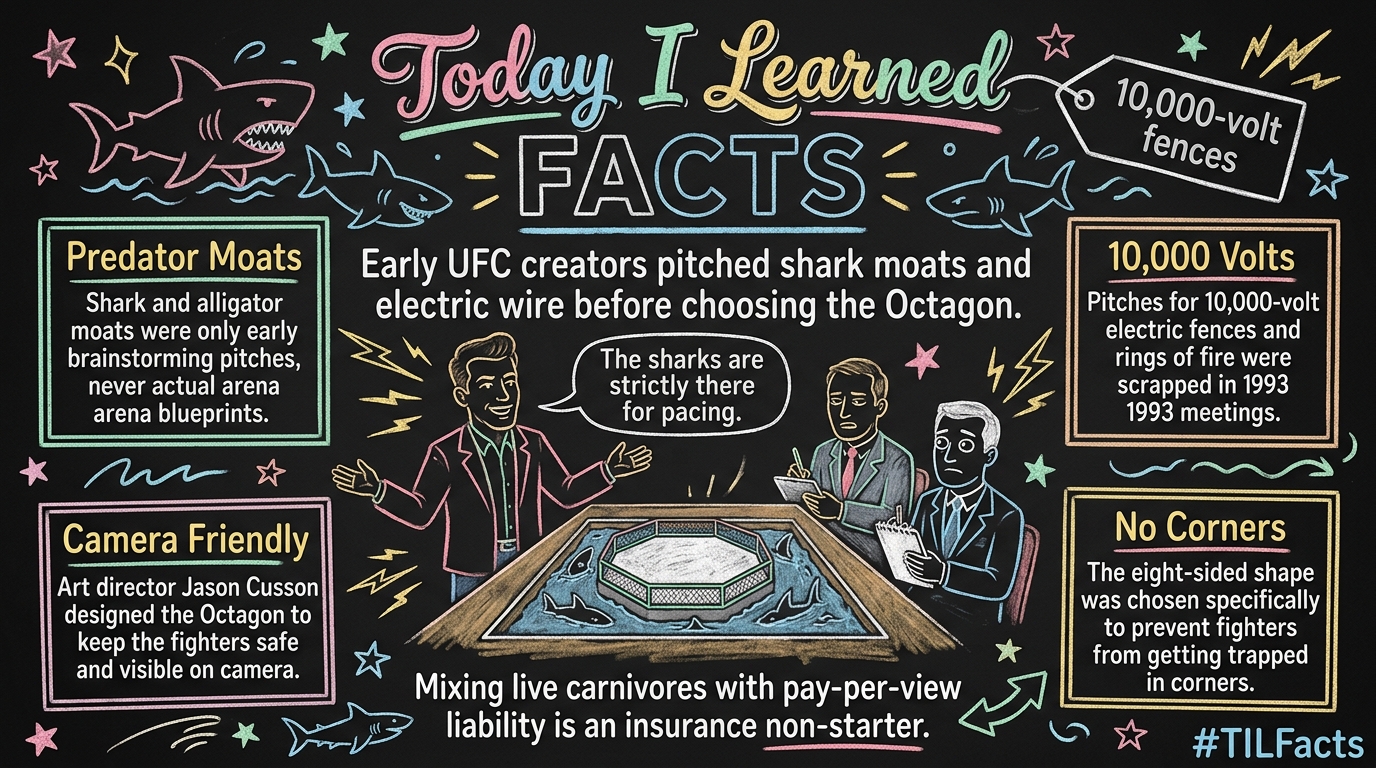
Before UFC 1 launched in 1993, its creators genuinely tossed around ideas like electrified wire perimeters, rings of fire, and moats filled with live sharks or alligators. These were Hollywood brainstorming spitballs rather than blueprint drafts, dismissed almost instantly because mixing live carnivores with pay-per-view liability is an insurance non-starter. The production settled on an eight-sided chain-link cage, leaving the man-eating predators entirely in the writers room.
Key Highlights
- 1Shark and alligator moats were only early brainstorming pitches, never real blueprints.
- 2Pitches for 10,000-volt electric fences were thrown out during 1993 creative meetings.
- 3Art director Jason Cusson designed the Octagon to keep fighters on camera safely.
- 4The eight-sided shape was chosen to prevent fighters from getting trapped in corners.
The Deep Dive
In 1993, martial artist Rorion Gracie, adman Art Davie, and director John Milius teamed up with pay-per-view distributor Semaphore Entertainment Group to stage an all-styles combat tournament. The objective was spectacle, and early creative meetings operated without guardrails. Davie and Milius threw out gladiatorial arena pitches that included surrounding the mat with barbed wire, 10,000-volt electric fences, and trenches packed with live sharks, alligators, or piranhas.
These proposals were pure Hollywood blue-sky spitballing. The group needed an enclosure where fighters could not tumble out, but traditional boxing rings allowed grapplers to slip between the ropes. Rather than solving that problem with standard venue staging, the creators treated the brainstorm like an action movie pitch, seeing how far theatrical cruelty could be pushed on paper before someone intervened.
Veteran referee Big John McCarthy and the original co-founders later clarified that these lethal setups were never close to engineering, funding, or construction. No contractor was ever hired to plumb an arena-sized aquarium or secure animal-handling permits. The production team immediately ran into the wall of basic municipal safety codes, arena insurance limits, and sheer common sense.
Retellings often exaggerate these boardroom pitches into real, near-miss blueprints, claiming the sport was one executive meeting away from feeding losers to reptiles. In reality, the ideas died in the same room where they were uttered. Hollywood art director Jason Cusson solved the actual confinement problem simply by sketching an eight-sided, vinyl-coated chain-link enclosure that kept fighters inside while remaining visible on camera.
The resulting Octagon became the universal trademark of modern mixed martial arts. Its eight-sided geometry was chosen to eliminate 90-degree corners where a fighter could get permanently trapped, balancing combat fairness with television visibility. The sport ended up revolutionising combat athletics not through cartoonish medieval death traps, but through a practical piece of production fencing.
Sources
Discussion
No comments yet. Be the first to share what you found surprising.