
 Submit a TILF
Did the FDA Legally Rule That Pringles Aren't Potato Chips?
The sources below were found by search, checked to be reachable, and support this claim as stated.
Why did the US Government Legally Defined Pringles as Not Potato Chips?
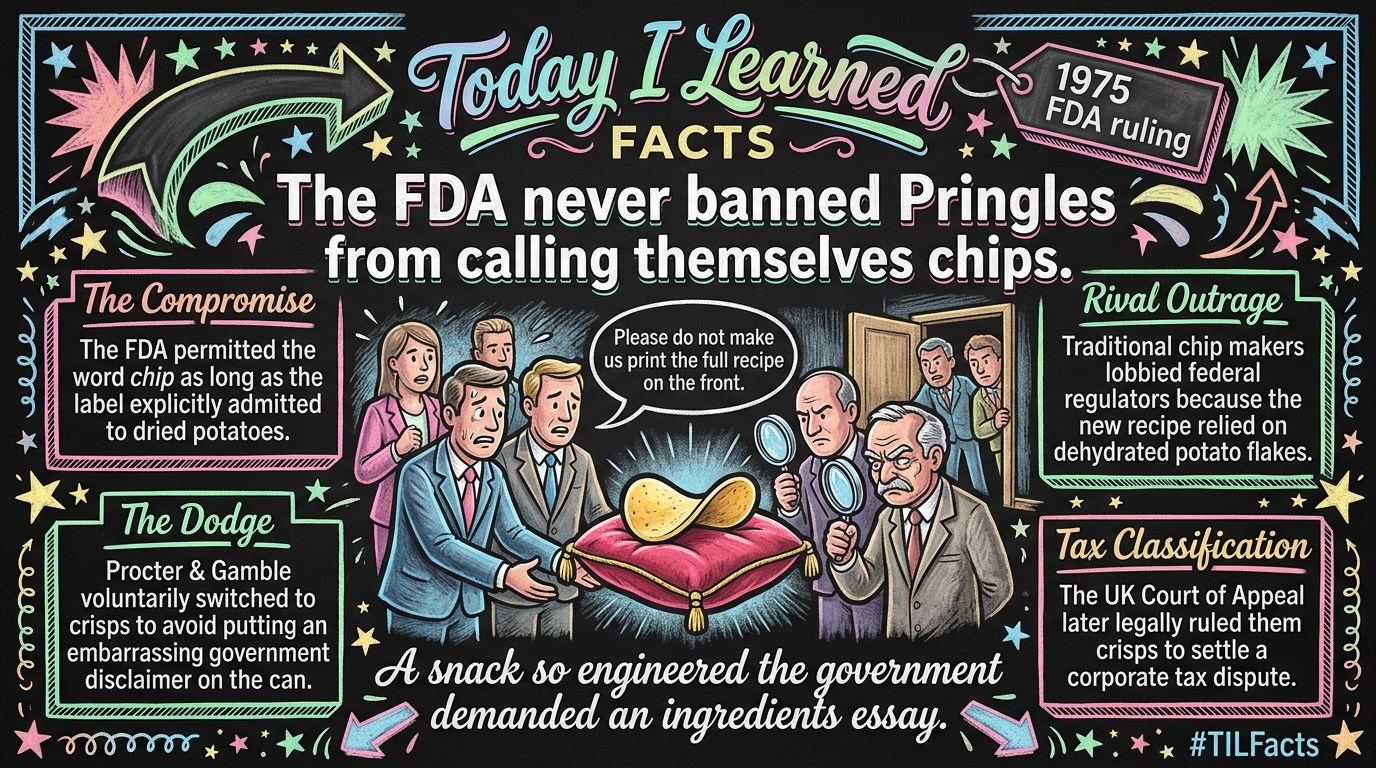
Whether the US government legally declared Pringles are not potato chips remains disputed. While critics argue FDA rules effectively stripped their chip status, the agency actually allowed Pringles in 1975 to use the word chip with the disclaimer 'potato chips made from dried potatoes,' prompting Procter & Gamble to adopt 'potato crisps' instead.
Key Highlights
- 1The FDA permitted Pringles to use chip if accompanied by a dried potato disclaimer.
- 2Procter & Gamble voluntarily adopted the name crisps to avoid clunky FDA labeling.
- 3Traditional chip makers lobbied the FDA because Pringles used dehydrated flakes.
- 4The UK Court of Appeal later legally declared Pringles to be crisps for tax purposes.
The Deep Dive
The legend that the US government banished Pringles from the chip aisle stems from a long-running turf war between snack giants. In the 1970s, traditional chip manufacturers represented by the Potato Chip Institute International were furious that Procter & Gamble was gobbling up market share with a uniform, saddle-shaped snack pressed out of dehydrated potato mush.
Traditional makers argued that a real chip must be a single, direct slice of raw potato dropped straight into hot oil. In response, the US Food and Drug Administration stepped in during 1975 with regulation 21 CFR 102.41. The agency did not ban Pringles from using the word chip; instead, it ruled that any snack formed from dehydrated flakes had to declare itself as potato chips made from dried potatoes in prominent lettering.
Faced with a government-mandated disclaimer that sounded more like an industrial warning than a snack food, Procter & Gamble simply opted out. Instead of printing the mandated subtitle on every can, the company renamed them potato crisps in the American market and bypassed the rule entirely.
The myth gained a second life decades later across the Atlantic, where the definition of a crisp actually did go to trial. Between 2008 and 2009, Procter & Gamble argued in British courts that Pringles contained only about 42 percent potato and were therefore exempt from standard value-added tax on crisps, winning briefly before the Court of Appeal ruled that Pringles were legally crisps after all.
The result is a tangled web of snack law where people constantly conflate an American labeling compromise with a British tax evasion attempt. The US government never said Pringles could not be chips, it merely demanded honesty about the potato paste.
Sources
Discussion
No comments yet. Be the first to share what you found surprising.